Where the Dust Settles - Watson RFA, part 2: Sign-and-Trade
UPDATE
August 20, 2026 - Denver S&T Watson to Cleveland, taking back solely draft capital. To see that update, please scroll to the bottom.
###
We are just over a month into 2026 NBA Free Agency and the RFA discussions for Watson have stalled to a staring match. All meaningful cap space has been allocated and both sides are left with external Sign-and-Trade frameworks to contextualize their position at the RFA table and further define their negotiation posture. This two-part article analyzes all possible S&T scenarios involving Denver, Milwaukee, and Peyton Watson. Analyzing this scenario will take us on a hobbit’s journey through some rarely-visited corners of the CBA, but never lose sight of the central question:
whether any of these options meaningfully alter the leverage point of the RFA game between Peyton Watson and the Denver Nuggets.
Our preliminary breakdown of Watson’s RFA game can be read here.
Part I breaks down every vehicle available to Denver at their current cap position.
Part II breaks down Jaime Jaquez Jr.’s own RFA case and how that would affect a Watson S&T.
PART I
Nuggets S&T Watson for pick(s)
The simplest transaction structure under the CBA would be to Sign-and-Trade Watson to Milwaukee in exchange for solely draft capital. The Bucks could acquire Watson, up to $25,706,566 via the Giannis STPE, or the 1st Apron – whichever is smaller at the time of the transaction. The Nuggets would generate an STPE worth half of Watson’s 2026-27 cap hit because of the Base Year Compensation Rule, which I covered in this previous article. Milwaukee is already hard-capped at the 1st Apron. Denver would be hard-capped at the 2nd Apron if they use the STPE to acquire a player at a later date.
While this would be a somewhat efficient utilization of cap exceptions for Milwaukee, the Bucks are currently only $2,857,796 under their hard-cap at the 1st Apron. In order to acquire Watson via this transaction structure, Milwaukee would need to dump significant salary and/or send out sufficient matching salary.
Conclusion: Legally viable, but would be a difficult move for Milwaukee to set up.
Nuggets S&T Watson for player(s) and pick(s)
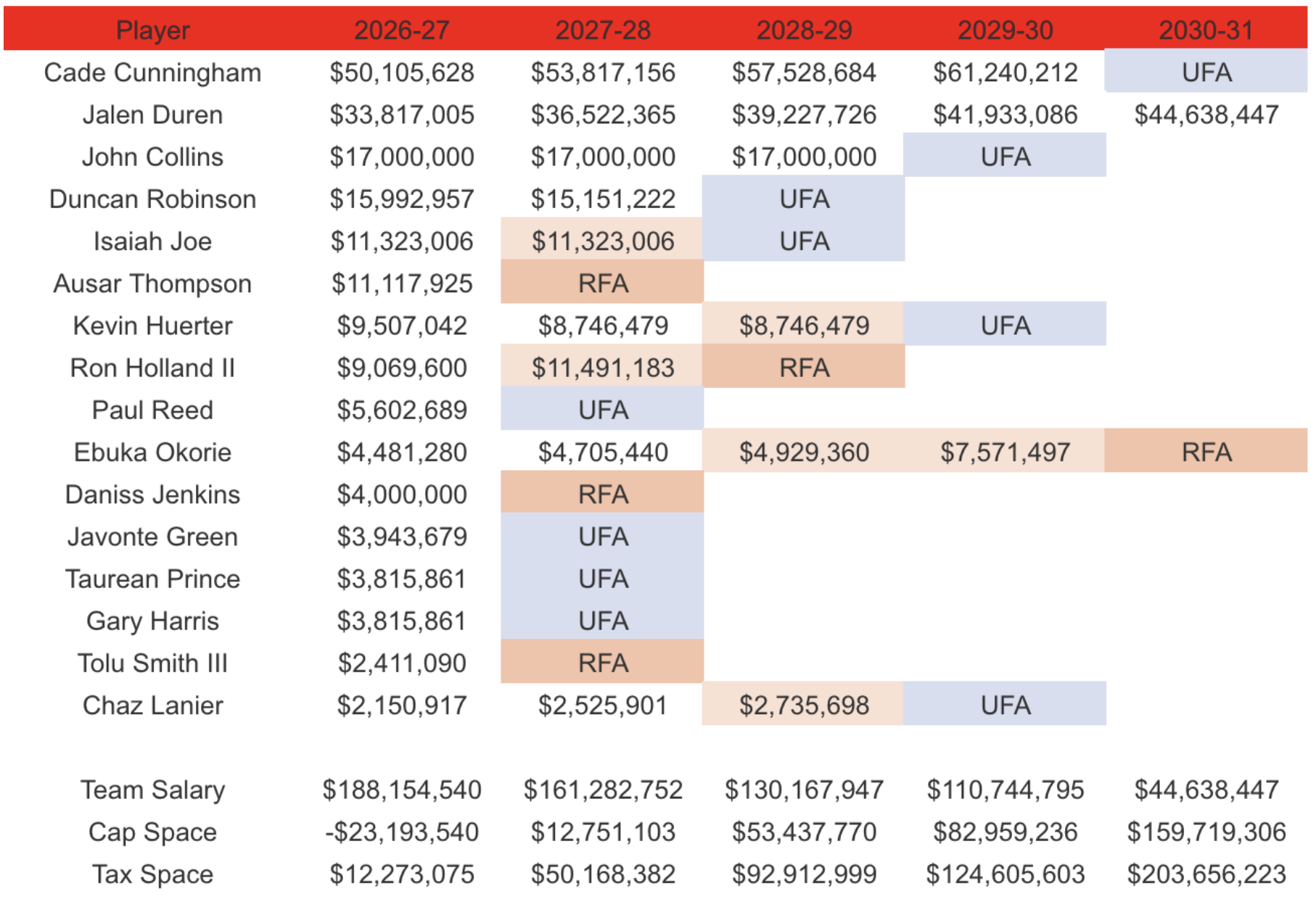
Denver is currently $6,178,496 under the 2nd Apron. Assuming that they remain above the 1st Apron (which is almost guaranteed this late in the offseason), in order for the Nuggets to acquire a player in return, they would need to do so via a Traded Player Exception.
There are only two TPEs that fit their limitations:
The Standard TPE; and the
Aggregated STPE
Both TPEs are credited the same for the purposes of trade math and both enable the Nuggets to acquire one or more players. But only the Aggregated STPE enables the Nuggets to send out multiple players. The cost of utilizing the Aggregated STPE is that the Nuggets would be hard-capped at the 2nd Apron for the remainder of the season. Additionally, Watson is almost guaranteed to trigger the Base Year Compensation Rule, which will add another layer of complexity.
Standard TPE
From Denver’s perspective, the STPE creates a narrow range of viable trades as the trade math is very asymmetric. An STPE in conjunction with a BYC means Denver can only take back half of Watson’s salary (they would not be able to get the additional $250,000 unless they dumped significant salary) – but his incoming value on Milwaukee’s side would be accounted for at 100%. For example, if we apply the Fair Market Value range we established in our previous Watson RFA analysis of 13.00% - 14.75%, Denver would only be permitted to bring back up to $10,972,465 - $12,415,874 in salary, but Milwaukee would have to account for Watson’s full $21,444,930 - $24,331,748 cap hit.
If we focus only on Denver’s perspective for a moment – this structure limits acquisition to twelve Bucks players, eight of whom are currently trade restricted. This leaves only AJ Green, Kevin Porter Jr., Ryan Rollins, and Jericho Sims eligible as of this writing. However, rookies Brayden Burries and Nate Ament are trade-eligible August 4th and 7th respectively, and Jaime Jaquez Jr., Kel’el Ware, and Kasparas Jakucionis are trade eligible on September 6th. Milwaukee likely protects Burries, Ament, Ware, and Jaquez Jr. For Denver, I assume the priority would be Rollins, Jaquez Jr., Jakucionis, Ware and Green - in that order.
If we apply the low-end of Watson’s range at 13.00%, the Nuggets can take back any one player listed above. However, given Milwaukee’s proximity to the 1st Apron, the only 1:1 trade that does not necessitate a large requisite salary dump would be sending AJ Green and his $10,044,644 contract back. (If Milwaukee were to waive Nance’s non-guaranteed $2,537,526 contract, Milwaukee could sign Watson up to $17,977,492 which is 10.90% of the salary cap). Any other 1:1 trade would require Milwaukee to clear $10M+ in salary first.
Alternatively, Denver can take back any combination of players up to $10,972,465.
Currently, Milwaukee has a roster crunch with seventeen rostered players and Denver has a minimum roster crunch with only eleven contracted players. A 1:2 trade would move both teams in the right direction.
While Denver would be acquiring via an STPE under this framework, Milwaukee’s options are limited to acquiring Watson via the Giannis STPE or generating an Expanded TPE. The Giannis STPE would be the simplest method, provided Milwaukee trades enough salary to create sufficient space under the 1st Apron to acquire Watson. But, if Milwaukee wanted to preserve their $25M TPE for an additional acquisition later this season, then the only practical avenue available would be for them to trade 2 or 3 players via the ETPE. Here are five legal trade combinations plus the maximum ETPE Milwaukee could generate; the far right displays the corresponding maximum value Watson could sign for.
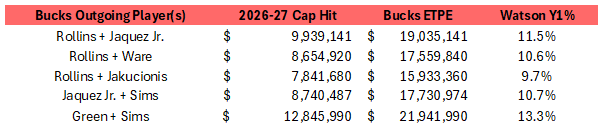
Given Milwaukee’s proximity to the 1st Apron, and their effective forfeiture of the Giannis STPE if they go down this route, any transaction utilizing this structure presents significant cap momentum costs and would reduce the value Milwaukee is willing to pay. Additionally, Milwaukee’s position on Rollins is uncertain. He is a great player on a great-value contract (I would argue one of the highest value contracts in the league), which is precisely why his greatest value to Milwaukee at this juncture may be as a trade asset rather than a potential piece of the next great Bucks run. And depending on the value Watson signs for, this could end up being a lot to sacrifice; especially for a player who could take the Qualifying Offer and enter Unrestricted Free Agency next season. Milwaukee’s posture might just boil down to an unwillingness to include several premium assets which would reduce Watson’s leverage at this juncture. The last two trade packages might make the most sense for both sides, especially if Denver prioritizes taking a pick back.
-
Herro is in the final season of his Rookie Scale Extension where he will earn $33,000,000 before entering Unrestricted Free Agency next offseason. He is Extension eligible but he is trade ineligible until September 6th. It is uncertain whether Herro and Milwaukee will pursue a Veteran Extension.
I would be surprised if Herro is not being shopped around, but for the purpose of this article, Herro’s $33,000,000 salary is too large to fit in any Watson S&T. (Aside, but even for Detroit, who has been rumored as a Herro destination, Herro cannot be traded for a Duren S&T given the same BYC constraints)
Here is the same table with some possible three player trades.
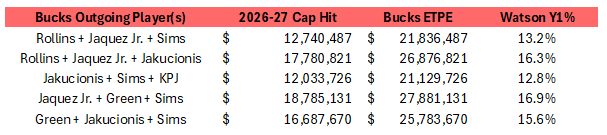
As you can see, adding a third player has the triple threat benefit of: 1) alleviating Milwaukee’s maximum roster crunch while 2) alleviating Denver’s minimum roster crunch and 3) creating a larger ETPE for Watson to sign into.
Denver taking any of these 1:X deals would take them over the 2nd Apron, bringing their tax bill close to $175M. And on Milwaukee’s side, they would still need to clear salary if Watson signs closer to the full respective ETPE. Some of these trades might move the needle, but both clubs would have meaningful issues and there may not be enough value in this trade for either side to entertain this structure any further.
Denver utilizes the Aggregated STPE
This transaction structure only makes sense if we completely deprioritize each team’s respective minimum and maximum roster counts and focused strictly on moving contracts. It would be unnecessarily difficult to effectuate in real life and I will be skipping it for the sake of this article.
Here is a quick summary of all the transactions analyzed thus far and their major limitations.
Watson S&T in exchange for only draft capital. Milwaukee has a roster crunch and would have to dump $15M+ before the transaction. Both the Watson acquisition and the requisite dump could cost them around three first round picks. Milwaukee says no. This does not increase Watson’s RFA leverage.
Watson S&T in return for one player. Milwaukee has a slightly lesser roster crunch and would still have to dump $10M+ before the transaction; Milwaukee also likely uses up most of the Giannis STPE. Watson S&T for Green and picks is the most reasonable structure here. Denver likely declines. This marginally increases Watson’s RFA leverage.
Watson S&T in return for two players. Milwaukee gets within roster range and they would only need to clear ~$7M before the transaction. The most likely trade at this permutation is probably Jaquez Jr. and Sims, Milwaukee could retain the Giannis STPE. Denver would enter the 2nd Apron. Milwaukee’s valuation of Jaquez Jr. is the unknown variable here - but my guess is that they would favor taking a chance on Watson’s ceiling over Jaquez Jr.’s, even at a contractual premium – and they are in a great place to be taking some aggressive bets on upside. This structure comes down to draft capital. This marginally increases Watson’s RFA leverage.
Watson S&T in return for three players. Milwaukee ends the transaction at a sufficient roster size and would still need to clear a few million dollars; which they may be able to do just by waiving Pete Nance’s non-guaranteed $2,537,526. Milwaukee could also retain the Giannis STPE. Denver would enter the 2nd Apron. I think a Jaquez Jr., Green, and Sims return makes a lot of sense for Denver’s rotation – however, this would add $18,785,131 to Denver’s salary and would Denver not simply prefer to retain Watson at a marginally higher figure? Denver says no ultimately but the possibility may marginally increase Watson’s RFA leverage.
Watson S&T plus another Nugget in return for multiple players. Needlessly complex. Unrealistic given roster constraints and apron limitations.
There is a legal path at each transaction. However, the requisite moves, opportunity costs, and interests of each club are sufficiently distant enough that I cannot say there is one clear standout at this juncture; only the 1:1 AJ Green trade or the 1:3 return even seem plausible.
There is one more transaction, and it is the most structurally complex of the group. It requires understanding Jaime Jaquez Jr.’s RFA case first.
Part II
Jaime Jaquez Jr. Rookie Scale Extension?
Jaime Jaquez Jr. was the subject of the next Pon Sports RFA article before Milwaukee entered Watson’s RFA discussions. Part II of this article will be a condensed analysis of Jaquez’s RFA case and how that could play into Watson’s current RFA game.
I would characterize Jaquez’s game as a big-guard who is at his best in the open-court and slashing or cutting to the rim. He is an opportunistic playmaker and a willing passer, but I would not consider him a primary creator yet. His halfcourt shot diet reminds me of New Orleans-era Tyreke Evans. A big, physical guard who does not hesitate to take a quick, strong first dribble in from the arc to hunt down a driving lane and pull out a crafty finish around the rim. And when his first instinct to drive is contained, he can rely on a crafty post-game off one, two, and off-footed push shots that have shades of Jalen Brunson at times. However, he can struggle defending lead guards and bigger forwards, and his three ball has been inconsistent through his early career.
This blend of strengths and weaknesses is fairly unique in the modern game and was undoubtedly a contributing factor towards his recent success in Miami as a high-pace lead backup. He was difficult to build precedent for but here is a comparative pool through their first three seasons, followed by their second contract details on the right:

This is a pool of big-guards and forwards who, like Jaquez Jr., generally struggled a bit to find their footing and place in the league through their first three seasons. Jaquez Jr. has started the second-fewest games of this pool, but he has the second-highest usage, and third-highest VORP. His points per game are second highest and his assists per game is in the top half of the pool. This group of players all generally struggled to shoot the three through their first three seasons, which certainly affected their stock going into their second contract. For the condensed valuation of this article, Jaquez’s career totals fit well within this pool statistically, where the simple average is 10.90%.
Here is what 10.90% looks like in 2026-27 and in 2027-28, when the first extension year would occur.

This models out to $18,966,000 in 2027-28, where the 4-Year AAV is $21,241,636. My immediate reaction is that this sounds a shade too high for a bench player; however, Naz Reid who has a comparable role off the bench is set to receive ~14.37% in the same season. Ultimately, I think the league would need to see another year from Jaquez Jr. to better contextualize the value of his third season. And I am sure Jaquez Jr. is looking at this upcoming season as an opportunity to take his game to the next level and outplay the market I have presented today. However, currently, I am not certain which teams would be interested in this contract in a vacuum, let alone as a committed Offer Sheet next summer. In any event, this figure projects to be ~$3M over the NTMLE and if his value remains in this ballpark, I bet he gains significant interest at the full NTMLE.
With that in mind, how does this factor into a Watson S&T for Jaquez Jr.?
A Watson S&T for Jaquez Jr. is possible once Jaquez Jr. is trade-eligible on September 6th, provided the Bucks clear enough salary below the 1st Apron to acquire Watson’s new contract.
Denver’s biggest risk in acquiring Jaquez Jr. and letting him get to RFA is that his upward trajectory continues, he establishes himself as a starter, he outplays the market above, and he commands an Offer Sheet north of $25.000M. Now, this would be a very big leap, but a player with Jaquez’s motor, off-ball cutting instincts, and comfort running a second unit could thrive in Denver alongside Jokic. (Second, Jaquez Jr. will carry a $17.817M cap hold which likely does not affect Denver, but this would be a modest point of leverage if he were to remain in Milwaukee who projects to be a $75M+ Room club next summer)
On the other hand, Jaquez Jr.’s first three seasons have been either “hit-or-miss” and the biggest risk he runs is his contract year being another “miss,” which would squarely place him at or below the NTMLE. Additionally, Jaquez Jr.’s third season might have been the greatest benefactor of the Spoelstra/LaRoche high-pace, motion offense - which placed Jaquez Jr. to be in the right places and get the right touches to capitalize on his downhill physicality. The uncertainty whether that production will translate to a new team and system will be determined this year. From a more macro-CBA consideration, the annual BRI delta is flattening out as the league struggles with the broader RSN business model – locking in a discrete contractual figure now (as opposed to a cap percentage), or waiting until next offseason might be prudent. Jaquez Jr. is represented by Aaron Mintz and I have no doubt he will get what he deserves. And lastly, chancing Restricted Free Agency has trended increasingly riskier for players as clubs have trended away from carrying Room under the current CBA. As covered throughout the Pon Sports’ RFA series, Kuminga, Grimes, Duren, and Watson can attest to how challenging this process has become.
Assuming Denver is dead-set on acquiring Jaquez Jr. and both sides are equally-motivated to find a peaceful resolution, a nice middle ground for all of these factors could be something around a three-year Rookie Scale Extension starting at 10%, max raises, and a 15% trade kicker. That Extension would begin in one season and would look like:

This Extension is a fairly equitable starting point that balances both sides’ considerations in value and term length. Denver gets four effective years of control including the final Rookie Scale year. By swapping Watson with Jaquez Jr., the Nuggets are effectively kicking the RFA can down the road, delaying the cap hit by one year. The annual cap hit is modest and suitable for a high-level bench player, low-end starter. And if Jaquez begins to outplay this contract, the sides could find a way out and build an extension, or move him along where he would be remitted 15% of the outstanding contract. Jaquez Jr. gets $56.375M of guaranteed money and can get back on the market at age 29 where he would be 7YOS eligible and should be able to sign at least one more 8+ figure contract. If one side were to reject this proposal, it would be Jaquez Jr. whose posture could boil down to “I saw how that played out for Avdija and I am willing to bet on myself for more.” On the other hand, if this feels like too significant a commitment for Denver, but Jaquez Jr. does not want to leave anything else on the table, the sides could borrow from Josh Hart’s contract structure (also negotiated by Aaron Mintz) and sign a non-guaranteed second season, with a Player Option in Year 3.
If both sides agree (to this or any other Extension), then there are only two ways for an Extension to be signed.
Denver acquires Jaquez Jr. AND signs him to a Rookie Scale Extension; OR
Milwaukee extends Jaquez Jr. AND trades him for Watson.
Denver signs Jaquez Jr.’s Rookie Scale Extension
As discussed above, the trade is possible between September 6th and the day before the Regular Season. Milwaukee would have to exhaust a majority of the Giannis STPE, Denver would generate a STPE worth a few million. Denver and Jaquez Jr. could sign the Extension any day after the trade but must sign before 6:00PM EST on the day prior to the start of the 2026-27 Regular Season. Jaquez Jr. would be trade-eligible immediately. For the duration of the 2026-27 season, he would be Poison Pilled for the purposes of trade math. Here is Denver’s position after that transaction:
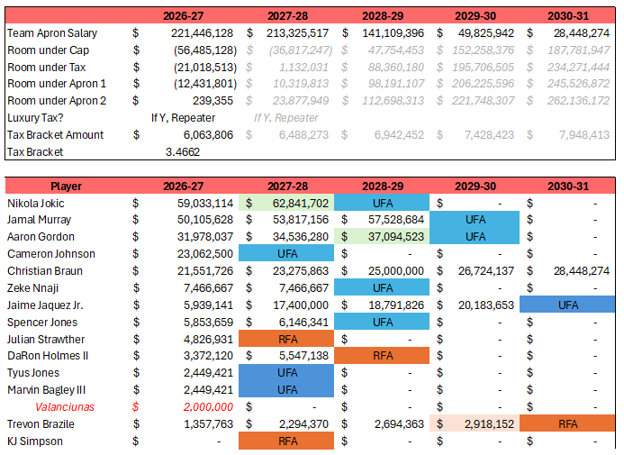
Milwaukee Poison Pills Jaquez Jr.
The second avenue to effectuate this Extension would be for Milwaukee to sign an Extension with Jaquez Jr. and then trade him to Denver. I need to be clear: this alternative order of operations has zero mechanical benefits for anyone. All player contract limitations remain the same and there is nothing that Denver could not just ‘do themselves’ upon acquiring Jaquez. However, Milwaukee using these next four weeks to work out an Extension removes all uncertainty about Jaquez Jr.’s future contract. And that certainty can improve their posture at the S&T discussion when and if the deal comes down to draft capital such as which years at what protections.
From Jaquez Jr.’s perspective, assuming my FMV is within the ballpark of his actual value, there is zero benefit for him at this juncture. There is no incentive to Extending with Milwaukee for this S&T; RFA or Extending with Denver would be more profitable. Theoretically though, he could use Milwaukee’s leverage point to get some of those clauses we alluded to above. Perhaps Denver would not include a 15% Trade Kicker, incentives, or even a Player Option. It is an opportunity for him to write his contract. If things fall through with Denver, then he would still have his Extension signed for the next few years. This order of events would invoke the Poison Pill Provision which would trigger a very unique occurrence of events, and the same outcomes from Part I would apply. Milwaukee has to dump several contracts, Milwaukee exhausts all of the Giannis STPE, Denver is a shade under the 2nd Apron, Denver exhausts their STPE.
Here is a calculator I built for this incredibly contrived scenario:
A 1:1 BYC S&T for a Poison Pilled Extension is extremely difficult to execute. For trade crediting purposes only, Denver’s outgoing salary is halved but their incoming salary is effectively multiplied by 2-3x.
A valid trade within this structure requires pushing each player’s Y1 cap hit in equal, but opposite, directions away from their FMV. The Giannis STPE translates to about 15.50% which is the effective maximum Watson can receive within this structure. With respect for those constraints, any valid trade would require Jaquez Jr. to leave too much on the table making any legal permutation extremely unlikely to occur in reality. Any valid trade also has significant upstream requirements for Milwaukee who would need to shed ~$20M+ in salary. In order for Jaquez Jr.’s Poison Pilled Extension to fit within the Watson BYC STPE,
a 3-Year Extension would have to start at ~8.00% (projected AAV: $15.033M)
a 4-Year Extension would have to start at ~7.55% (projected AAV: $14.188M)
a 5-Year Extension would have to start at ~7.15% (projected AAV: $13.436M)
Giving Jaquez Jr. the Extension modeled out in the previous section (3 Years starting at 10.9%) requires Watson to earn 20.15% ($33.240M) or more which is $7.533M greater than the Giannis STPE. Even on max declines, that deal would come out to $117M/4 and an AAV of $29.251M.
-
Short answer: They could, but the same asymmetric trade math would still apply - which is the greatest limitation for this transaction structure.
Additionally, Jaquez Jr. would generate an ETPE worth $12,128,282 which is less than half of the Giannis STPE. Milwaukee could add any combination of players discussed in Part I. While this would indirectly enable Milwaukee to increase Jaquez Jr.’s Extension value, while acquiring Watson at a reasonable value - it would not change Watson’s outgoing BYC. Denver could add more outgoing salary via another player, but the Aggregated STPE generates a novel set of challenges.
This entire framework is like a game of whack-a-mole.
There are far more practical solutions to doing a Watson for Jaquez Jr. swap including Extending Jaquez AFTER said S&T. I do not think this unique transaction structure alters the leverage point at either Watson’s RFA table or Jaquez Jr.’s Extension table.
CONCLUSION
There are a variety of viable vehicles for Denver to S&T Watson to Milwaukee. However, with respect for both clubs’ respective cap exceptions, apron limitations, and tax considerations - there are very few transactions that make sense in reality as each vehicle would have significant upstream requisites or downstream costs. Thus, I find that a S&T with Milwaukee does not materially alter the RFA leverage point between Watson and Denver. A wider possibility of trades would be possible if Denver can first clear the 1st Apron via a Gordon, Johnson, or Braun dump - but at this stage of the offseason, that would require an opposing STPE which would likely necessitate draft capital.
It is being reported that Denver is holding out around the NTMLE value and I anticipate Watson remains with Denver, signing for less than we projected a month ago - around $19M AAV - with a shorter term length to get back on the market sooner; possibly a 2 + 1 Player with a max trade kicker and incentives to make up anything he left on the table. Jokic’s Extension is a topic we did not explore in any article, but that could also be a leverage point Watson’s camp is likely trying to capitalize.
If Milwaukee does not extend Jaquez Jr. this summer, he will enter RFA. If his Extension discussions are around the projected 2027-28 NTMLE value of ~$15.871M (~9.12%), then I cannot see Milwaukee passing on that. However, that should be understood as a very conservative value, which is driven most by the clubs’ RFA risk exposure in 2027-28 as opposed to Jaquez Jr.’s underlying value. From Jaquez Jr.’s perspective, I am sure he is eager to build upon a phenomenal third season, prove his worth, and outperform this valuation. Therefore, I would say RFA is more likely than not.
FINAL UPDATE
August 20, 2026 - Denver S&T Watson to Cleveland, taking back solely draft capital.
Signing-and-Trading Watson for $20,465,116 (12.41%) triggers the BYC rule which means Denver generates a $10,232,558 STPE which can be credited for up to $10,482,558 in acquisition(s) if Denver ducks the 1st Apron. Because Denver is currently over the 1st Apron, they must use the S-TPE before it effectively expires at the Trade Deadline on February 11, 2027. If Denver acquires any player via the STPE, they will be hard-capped at the 2nd Apron. In return, Denver received a Cleveland unprotected 2031 FRP (the last year of Donovan Mitchell’s $272.885M/4 Extension), and a 2032 SAC SRP.
Cleveland likely acquired Watson via a Max Strus + Dennis Schroeder ETPE2, which was worth up to $40,566,036. The Schroeder/Mann trade between Cleveland and Washington had to be included in this transaction because Cleveland took back Cam Whitmore who makes $5,458,310. If Cleveland just assigned Strus, the maximum ETPE they could generate would be $157,590 shy of Watson + Whitmore. In addition to Watson and Whitmore, Cleveland could have taken up to $14,642,610 from Denver, Los Angeles, Washington, or Charlotte; however, the looming Harden extension and the 1st Apron hard cap prevented any material additions.Cleveland is hard-capped at the 1st Apron and the Strus ETPE2 is exhausted.
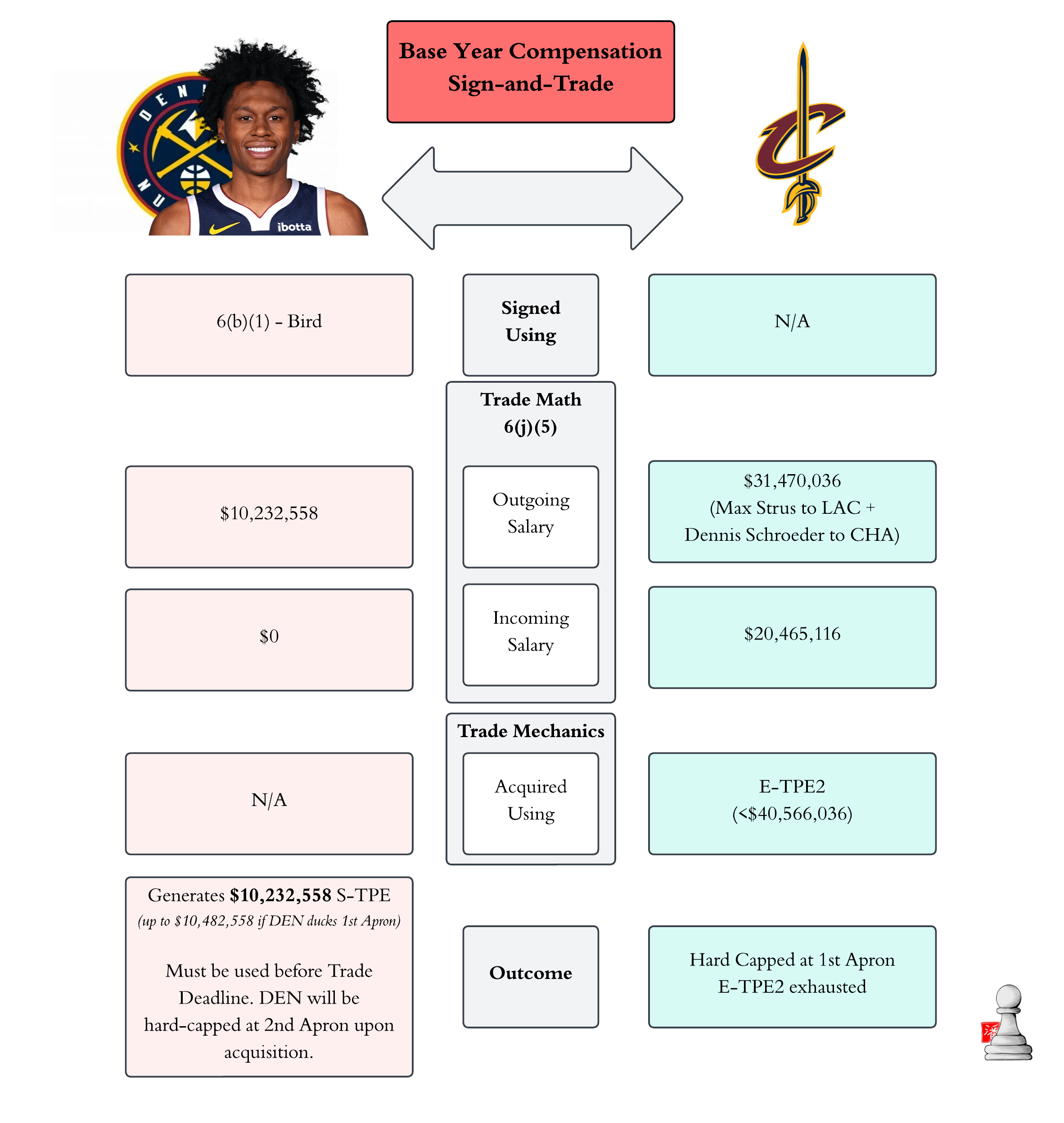
Final Thoughts:
Denver leaves the RFA Game with 13 rostered players, an additional unprotected first round pick, an STPE worth $10,232,558, and a projected tax bill of ~$33M. They lose the most exciting player in the transaction and will likely continue to struggle with depth and defense. Additionally, Nikola Jokic is unlikely to extend and he could walk next offseason. With all of these implications in mind, it is easy to say that Denver has lost the RFA Game. But when we consider how much it would have cost Denver to retain Watson, and the fact that they still have until February to fully “complete” this trade – I will refrain from judgment for now. There is still a chance they use their draft capital to take a swing and upgrade their perimeter. Oddly enough, Denver can use the Watson STPE to acquire Jaime Jaquez Jr. and Sims, which would bring this article full circle.
Watson leaves the RFA Game with $88,000,000 in guaranteed money and a Player Option (I heard he had a Trade Kicker but it has not been verified yet). I cannot grade him and his representation enough for holding out and getting close to the FMV range we set out in this article. The Player Option is immensely valuable and will give Watson the opportunity to effectively ‘opt-out and extend,’ which will drastically increase his leverage at the extension table;or he canopt-out and enter unrestricted free agency at 7YOS.
Thank you so much for making it this far. For business inquiries and feedback please reach out at:
Or, leave your information below.