UPDATE
October 21, 2026 - Detroit signed Jalen Duren to a $200M/5 contract via Bird Rights. To see a breakdown of the final structure and where that could lead, please scroll to the end.
###
RECAP
3.5 months ago, we broke down Duren’s RFA case. We concluded that 22.5% was an equitable starting point for RFA discussions; and that Detroit faced no real Offer Sheet threats.
2.5 months ago, we posted a Duren follow-up. We analyzed every viable BYC S&T avenue and concluded that a Duren S&T was extremely difficult to set up (especially any S&T involving Sacramento). Because these S&T rumors were structurally weak, we concluded that Duren would re-sign with Detroit for less than the 25.0% max with Detroit; specifically, around 20.0% - 21.0% of the cap.
In the last two weeks,
September 2: The Kings were floated as a 2027 UFA destination for Duren if he were to take the Qualifying Offer.
September 10: Duren’s camp increases the QO pressure.
September 11: Pistons reportedly increase their offer to $190M/5 (19.9%) and Duren reportedly holding out at $200M/5 (21.0%).
In the next 2.5 weeks,
Jalen Duren’s deadline to accept his Qualifying Offer expires on October 1, 2026. (Though, the parties can push this back to March 2027).
In short, the parties are holding out at striking distance, with the final stretch lying somewhere between 19.9% and 21.0%, when adjusted. I believe the Qualifying Offer is unlikely and a BYC S&T is also unlikely.
This third and likely final update will breakdown both parties’ 11th-hour considerations and how the remaining structural levers can be pushed and pulled to drive this deal across the finish line.
If we simply split the difference between Detroit’s $190M offer and Duren’s $200M offer, and then imply an annual structure of max 8% raises - then that contract would start at 20.50% in 2026-27.
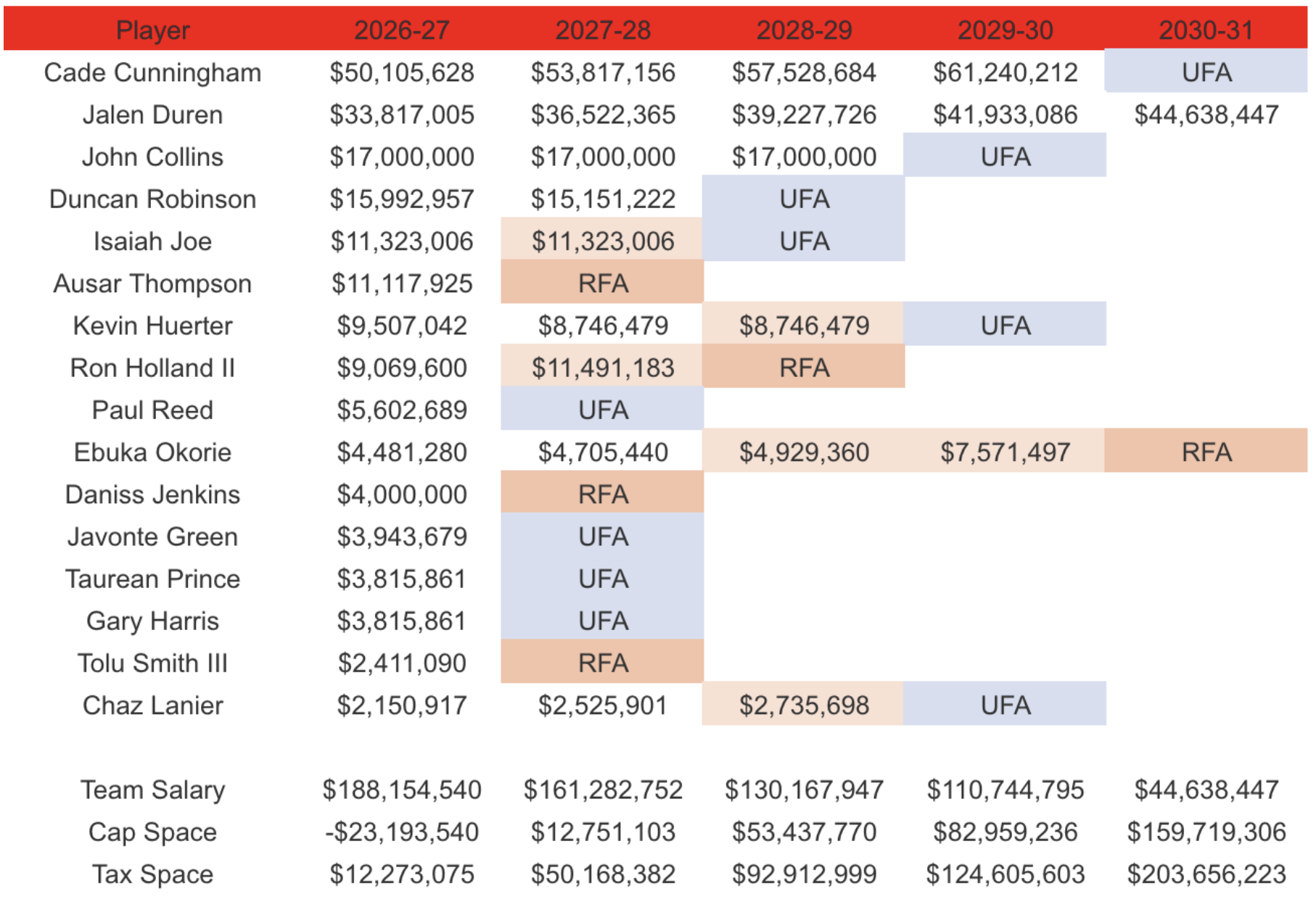
Here is Detroit’s books following the “split the difference:”
Duren’s total guaranteed money would be $196,138,629 and the 5-Year AAV is $39,227,726.
While the parties started miles apart and are now "only" separated by 1.10 Y1%, the final steps towards resolution of Duren's RFA Game will likely consist of much more than simply "splitting the difference."
Term Length
Given the scope of this article, we will be implying a five year term length; there is no reporting indicating otherwise and analyzing any alternatives would multiply the analytical depth.
Options
Given the scope of this article, we will be implying no Options in the fifth-season. A Club or Player Option would drastically increase the scope of this article, materially altering the leverage points discussed throughout this article - especially the Extension points.
Annual Structure
As of this writing, Detroit has 15 players rostered (13 guaranteed contracts), and $46,090,080 of space below the Tax threshold. That space below the Tax equates to 27.9% of the cap in 2026-27.
In the next two offseasons, Detroit has several key decisions to make which will meaningfully define the next great Pistons squad. Below are all the UFAs and RFAs Detroit will have to manage in the next two years:
2027-28:
Ausar Thompson RFA
Daniss Jenkins RFA
Tolu Smith RFA
Paul Reed UFA
2028-29
Ron Holland RFA
Isaiah Joe UFA
Detroit has a few big paydays coming in the next few years. Now, factor in Duren receiving ~$39.228M annually AND Cade Cunningham earning $53.817M annually. We can plausibly deduce that 2026-27 will be the lowest Team Salary that Detroit fields for the next three to five seasons. Also, factor in the fact that Detroit has not paid the tax since 2004-05, where they paid a whopping $760k on the tail end of back-to-back Finals appearances. All these considerations taken together shine some insight onto Detroit's cap position in the final stretches of this negotiation.
With ample space below the Tax this offseason, but limited cap flexibility in the coming years, the key cap strategy question at this juncture becomes:
What structural levers are available to minimize cap hit in later years?
Simplest Answer: Front-Loaded with 8% Decreases
Assuming no moves are made, the maximum Duren's contract can start at without going into the tax would be $46,090,103 (27.94% of the cap).
With max annual declines that contract looks like:

When compared to the same guaranteed sum with max increases, this contractual structure has immense benefits for Detroit's long-term cap horizon, which I will briefly list here.
lowers tax pressures in later years, as discussed above;
theoretically buys some flexibility with cap exceptions in later years;
theoretically makes it easier to become a Room club in later years;
from the perspective of trade math, the number of viable trade partners increases every year, as other contracts grow larger; and
precedent-setting for the rest of the squad.
-
Opinion
While it takes two to tango, and I believe both sides have had reasonable expectations throughout (except some of the S&T chatter). I wonder what this prolonged negotiation says about the balance of RFA in its current state.
I understand the value in exploring every contractual term, every lever. However, basketball teams are not built on spreadsheets or rule-statement analyses - and I wonder whether this deal could have been finalized a month ago with the same terms, sans any tension, resentment, or bad blood that these prolonged negotiations tend to foster.
From Detroit’s perspective, Duren’s RFA Game may have been an opportunity to write precedent. As noted above, they have a packed bargaining calendar the next two seasons. What better way to set the tone and establish negotiation posture than with an All-NBA caliber center?
While Detroit has managed their cap sheet well - and I am sure Duren’s inevitable contract will be no different - I am interested to see what all of this cost them, and how this case influences league-wide RFA strategy going forward.
Why would Duren’s camp say “no” to this structure?
Veteran Extensions are capped at 140% of the last season's cap hit (the declining structure above limits Duren's Extension to $43,877,778. That is less than what this contract structure starts at); and
Because agents want to maximize their player's market value. A declining structure and lower cap hits may foster perceptions of lesser value than the total or AAV would suggest.
A middle ground would be either a flat structure or a variable structure.
Flat Structure
Here is the same guaranteed total with 0% annual delta:

Duren’s maximum Extension would be $54,965,005, which would be worth approximately 26.9% of the cap in 2031-32, (assuming modest, flat annual growth of 5.50%).
If we assume Duren continues improving and we expect the cap to increase more than 5.50% annually, the flat structure has significant, tangible downstream restrictions for any Extension. In three to five seasons, this structure confines Duren to Extending for less percentage of the cap than he was eligible for this season.
Given the tenor of his RFA game, I would anticipate his camp holding out for a contract that is greater than $40.000M in 2030-31.
Variable Structure
Here is the same guaranteed total but with:
8% decrease in 2027-28;
8% decrease in 2028-29;
3% increase in 2029-30; and an
8% increase in 2030-31.

This structure presents the best compromise explored thus far. Detroit front-loads some of the cap hit, generating ~$11.7M in cap space across the final three seasons. This will be key as this young roster progressively matures through several large Extensions, enters that "salary cap event horizon," and subsequent roster upgrades are confined to the smallest Exceptions and margins.
When compared to the same guaranteed sum but with max raises, this contract generates the following cap relief:
$3,200,244 in 2028-29;
$4,618,908 in 2029-30; and
$3,893,080 in 2030-31.
Additionally, Duren would be eligible to Extend for $57,043,514 in 2031-32 which projects to be ~27.9% of the cap, assuming the same modest cap growth. These Extensions would be worth up to:
$184,820,985, for a three-year Extension in 2029-30; or
$255,554,943, for a four-year Extension in 2030-31.
If Duren was open to this concept but he still felt like he was leaving too much on the table, Detroit can meet him at $200M guaranteed by increasing the fourth season to 7.25%.

The total guaranteed sum would increase from $196,435,559 to $200,081,197. Duren would get the guaranteed figure he was reportedly holding out for. Detroit would get some breathing room on their long-term cap horizon.
When compared to the first structure ($196,138,629/5 with max raises), this contract is worth $3,942,568 more, YET the structure generates the following cap relief:
$3,200,244 in 2028-29;
$2,796,089 in 2029-30; and
$2,070,261 in 2030-31.
Duren would be eligible to Extend for $59,595,460 in 2031-32 which projects to be ~29.2% of the cap, assuming the same modest cap growth. These Extensions would be worth up to:
$193,089,290, for a three-year Extension in 2029-30; or
$266,987,661, for a four-year Extension in 2030-31.
-
A one-time trade bonus can be added to this contract. If I were Detroit, I would only be open to adding a trade bonus if the total guaranteed sum were closer to $190M; OR I would be willing to add the full 15% if I could get the front-loaded with max declines like above.
The trade bonus would enable Duren to recoup cash for anything he left on the table (one-time $22,123,250 cash payment if he were traded next offseason). If I were Duren's camp I would be very pragmatic about my future with Detroit given how RFA has played out.
For the purposes of the acquiring team’s Team Salary, Duren's cap hit would be calculated as: the applicable season's Regular Salary plus the trade bonus, allocated pro rata over the remaining years. In this example, Duren's cap hit would be Regular Salary + $5,530,813 ($22,123,250 divided by four).
For the purposes of trade math, the Incoming Salary is calculated the same as above. If we take the same example, Duren's Incoming Salary would be accounted for at $47,933,798 ($42,402,985 + $5,530,813).
For large salaries like Duren, this gives him a small modicum of structural control over where he is traded as he has unilateral power to reduce his trade bonus, effectively making his incoming salary easier to acquire. Duren could reduce his trade bonus down to 0%, which means he has a $5,530,813 range that only he can control. This enables him to effectively "exhale" slightly, reduce his contractual size, and squeeze into an STPE where he otherwise would have too much incoming salary. Under a 1:1 STPE swap, there are 16 players from Desmond Bane ($42,166,510) all the way up to Kevin Durant ($46,097,561) whom Duren could be swapped for, depending on how much of his Trade Bonus he retains.
Of course, Duren would be directly reducing his own cash bonus - however, that could be a valuable sacrifice if it meant going to a club of his choice with promises of a max Extension.
-
Annual performance bonuses can be added so long as the Regular Salary and Performance Bonus do not exceed the player's respective maximum. Likely and Unlikely Performance Bonuses are hard to project from my vantage point. But in this situation, I think they would be more likely to make it into the final contract the lower the guaranteed sum; the closer to $190M the final sum ends up at. As the total guaranteed sum approaches $197.5M and above, the less likely Performance Bonuses will be.
An additional consideration is that Performance Bonuses are included in Extensions; this means Performance Bonuses can be included in an Extension to increase Extension value on an originally-declining structure.
Conclusion
If the parties are this close on guaranteed money, then I do not think the Qualifying Offer or a S&T is likely. I think Duren re-signs with Detroit around $195M guaranteed, possibly up to $205M depending on the other clauses discussed throughout this article. Detroit's cap position greatly incentivizes front-loading this contract. However, max declines leave Duren with far too little to build an Extension from.
What to look out for in the coming days:
If Duren prioritizes Extension potential, then I would expect the total guaranteed remain around $195.000M or less, with a conventional structure that starts low and has max raises. Something starting around 20.50% ($33,817,005). Total guaranteed: $196,138,629 with an AAV of $39,227,726.
If Duren prioritizes guaranteed money in this contract, then I would expect the final structure to be flat or variable:
If the guaranteed sum is less than ~$197.500M, then I imagine a flat structure or a flat-to-raise in the final year would make sense. Something starting around 23.80% ($39,260,718) with 0% annual delta, perhaps a raise in the final year or two. Total guaranteed $196,303,590 with an AAV of $39,260,718.
If the guaranteed sum is greater than ~$197.500M, then I imagine Detroit expects some cap and tax flexibility in exchange. A variable structure like the last example makes a lot of sense for both sides. Something starting at 26.00% with two max declines and two max/near-max increases. Total guaranteed $200,081,197 with an AAV of $40,016,239.
If Duren completely deprioritizes Extension potential and wants to maximize his guaranteed money at this contract, then Detroit can front-load a contract starting at 29.40% (assuming Tolu Smith's non-guaranteed contract is waived/traded prior to his fully-guaranteed date of January 10, 2027) with max declines. Total guaranteed: $203,693,843 with an AAV of $40,738,769.
FINAL UPDATE
October 21, 2026.
Detroit signed Jalen Duren to a $200M/5 contract via Bird Rights. Y1% at 24.4%, ~21.5% when adjusted to standard structure.
Duren leaves the RFA Game with $200M in guaranteed money. He will be the 43rd highest-paid player this season (~93rd percentile). This current contract ends in 2030-31 when Duren will have 9YOS; after 2029, he is eligible to sign a nine-figure Extension worth:
$194,920,471 for a three-year Extension, signed in 2029 (AAV: $64.973M); or
$269,519,666 for a four-year Extension, signed in 2030 (AAV: $67.380M)
RFA Game Grade: Duren
I think Duren's camp did a great job holding out for an equitable outcome. As we have detailed throughout his RFA case, his camp had relatively little leverage at the RFA table, which only decreased as virtually all available Room was committed by the end of the Moratorium. As you see above, over the past five months, our analysis consistently arrived at a final value around 20.0% - 21.0%.
Judging Duren's camp solely on guaranteed sum and preserving Extension value: Duren gets an A+.
Looking back to the Rookie Scale Extension deadline last October all the way through completion of the RFA Game - I do not think Duren’s side could have utilized their cap leverage much better. Obviously there were on-court considerations that drastically adjusted his market value this summer, but all cap things considered, I think a $200M/5 guaranteed contract was a near-optimal outcome.
RFA Game Grade: Detroit
Detroit leaves the RFA Game with $194,498,178 in Team Salary committed to 15 players. The Pistons are $29,537,178 over the Salary Cap and they have $5,929,437 of space below the Luxury Tax. However, Detroit can generate up to $22,333,484 in space below the Luxury Tax if they waive Duncan Robinson and Tolu Smith's non-guaranteed contracts before January 10, 2027 (which I find unlikely). I previewed Detroit's cap sheet benefits of front-loading a variable structure contract one month ago, which you can read above.
Judging Detroit solely from the RFA Game, on guaranteed sum, and contractual structure: Detroit gets an A-.
While Detroit held all the cards for the entirety of the RFA Game, I grade them highly for
maintaining their posture throughout a very lengthy negotiation;
deflecting any S&T threats, which we identified as baseless from a cap perspective;
signing an equitable contract, which I think Duren has a chance to outperform as he develops on both ends;
baking in a contractual structure which will enable moderate cap flexibility to make one to two marginal roster upgrades in the low-rotation for the next two to three seasons; and
excluding a Trade Bonus and a Player Option (the latter of which this administration seldomly signs)
Stepping away from Duren’s RFA Game
While both sides may have reached an equitable outcome, this was a lengthy, drawn-out negotiation that required the pressure of the Qualifying Offer's hard deadline to finally reach a resolution. Since signing two weeks ago, I have only read positive things in the news. But also, just from where I sit, the tenor and spirit of how the RFA Game played out strongly suggests there is an inherent disparity between how the parties each value Duren's on-court production relative to the cap commitment he has earned. I do not think Duren is overpaid, but rather - that his on-court value, his strengths and limitations, relative to Detroit's current construction and on-court needs is not fully aligned.
Should Detroit's deep playoff aspirations fall short again this season, Detroit's homegrown trio of Cade Cunningham, Jalen Duren, and Ausar Thompson - whom combine for $117,489,086 in 2027-28, a projected 66.6% of the cap - will have to be reconsidered. In this scenario, I would expect one of Duren or Ausar Thompson to be traded.
(Aside: but I anticipated one would be traded this offseason and was surprised to see both on the roster for opening night)
Trading Duren
Duren's $40,160,643 2026-27 cap hit cannot be traded until January 15, 2027.
For the 2026-27 Salary Cap Year, this leaves Detroit with two windows to trade Duren:
a 27-day window to trade Duren before the Trade Deadline on February 11, 2027; and
a ~28 - 80-day window in April/June until June 30, 2027 when the Salary Cap Year ends. (Please note trades enacted during this window are relatively uncommon)
After the Moratorium, the trade window opens again on July 6, 2027 and Duren's 2027-28 cap hit of $36,947,792 will be credited for the purposes of trade math.
Below is a table outlining the maximum TPE value Detroit can generate by Duren's cap hit, in both Salary Cap Years.
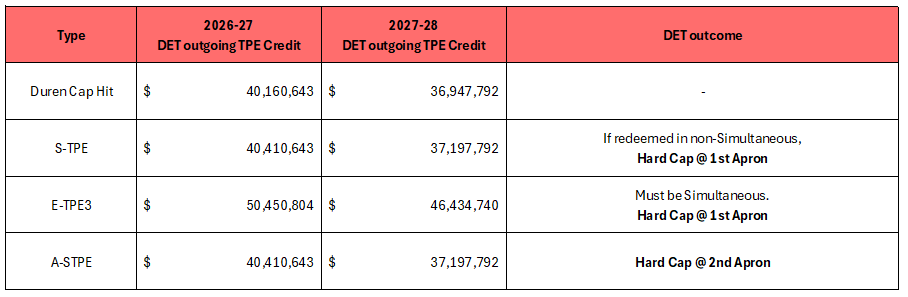
Assuming Detroit continues to duck the Tax, we can focus our analysis to acquisition via the S-TPE and E-TPE3 for both years.
Trading Duren via S-TPE
Analysis for Detroit acquiring/generating via S-TPE in either season is fairly straightforward. They can only send out Duren and can essentially:
acquire one or more players, up to $40,410,643 in 2026-27 / $37,197,792 in 2027-28;
generate up to $40,410,643 in 2026-27 / $37,197,792 in 2027-28; or
some combination of both up to the respective TPE limits.
If Detroit goes down this juncture, then it is in their best interest to trade Duren during the 2026-27 Salary Cap Year as they will generate a $3,212,851 larger S-TPE than if they traded during the 2027-28 Salary Cap Year.
Trading Duren via E-TPE3
Analysis for Detroit acquiring via E-TPE3 in either season is also straightforward. They can send out multiple players, and acquire multiple players, however this transaction must be completed Simultaneously.
If Detroit were to trade Duren by himself, Detroit can acquire one or more players, up to $50,450,804 in 2026-27 / $46,434,740 in 2027-28.
Just as with the S-TPE, if Detroit goes down this juncture, they can acquire up to $4,016,064 more if they trade Duren during the 2026-27 Salary Cap Year. This TPE is large enough for Detroit to acquire any player outside of the 11 highest paid players in 2026-27. In 2027-28 the number of eligible acquisitions decreases to any player outside of the 26 highest paid players.
Duren’s Contractual Structure Has unique Trade Benefits
While Duren's contractual structure generates cap relief for Detroit, it would also be uniquely valuable as a trade piece this season - particularly as a trade piece in exchange for a more expensive contract from a cost-strained team.
For example:
Because Duren's 2027-28 salary takes a max 8% decline, trading for Duren at the end of the 2026-27 Cap Year means that Sacramento sends a $45,472,000 salary to acquire a $40,160,643 salary, of which they will only pay $36,947,792 in 2027-28; saving $11,660,208 compared to Sabonis' 2027-28 cap hit. Sacramento is essentially acquiring a young, all-nba caliber center who is under team control for four seasons; starting at a projected 20.9% of the cap with moderate annual raises.
For Detroit, this is not a great swap on its face. So why would the Pistons do it? Again, we only entertain this junction if Detroit has to shake up their roster. Yes, they get older and more expensive for 2027-28. However, they would likely receive ample unprotected draft capital, AND Sabonis' current contract expires after the 2028 season; affording the Pistons a prime avenue towards becoming a cap space club in the middle of Cade Cunningham's prime.
Final Final Conclusion
I grade Duren and Detroit highly for the final outcome of the RFA Game. Duren got paid what he was worth, and Detroit was able to get as much cap flexibility as they reasonably could get. Despite the lengthy negotiation, both sides appear to have taken this process in stride. I think there is a chance Duren continues to develop and outperforms this contract; and I expect Detroit to continue improving, putting together a few deep playoff runs. However, if they fail and Detroit needs to shake up the roster, Duren and his contract will be immensely valuable in the trade market for cost-constrained clubs.
Thank you for reading, for business inquiries please reach out to
If you would like to join our newsletter and be notified of new posts, please subscribe below: