Understanding the Hornets: Why Charlotte Traded LaMelo Ball
The Charlotte Hornets have spent most of the last decade searching for direction. Since their last playoff appearance in 2016, they have changed ownership, overhauled the front office, moved from Steve Clifford to James Borrego and back to Clifford, hired Kenny Atkinson before he withdrew, and turned the team over to Charles Lee. Initially, LaMelo Ball appeared to end that search.
Ball won Rookie of the Year, was an All-Star in Year 2, and he led Charlotte to consecutive Play-In appearances before injuries and roster turnover stalled the momentum. Across the nine seasons after that playoff appearance, from 2016-17 through 2024-25, the Hornets went 277-434 (.390) and did not return to the playoffs.
After three seasons in which Charlotte went 67-179, Lee’s second year finally supplied evidence of progress. The Hornets played with more movement, shared the ball, and defended with an intensity the franchise had rarely sustained. After opening 4-14, they finished 44-38 by going 28-10 over their final 38 games.
A 25-win improvement normally buys a core another season. Charlotte traded Ball anyway. After taking what he called an “honest look in the mirror,” Peterson said the Hornets had to judge their progress against a larger goal, as “The goal is never to compete for a Play-In spot.”
Charlotte ultimately sent Ball and Josh Green to Minnesota in a four-team deal that brought back Naz Reid, Mo Gueye, draft assets, and a $41.020M trade exception.
This article will cover:
Charlotte’s promising 2025-26 season;
What prevented them from advancing further in the postseason;
The recovery of Ball’s trade value;
What Ball’s Extension would look like;
Which all contributed to Charlotte hitting the reset button; and
While they will be worse on the court, this move redefines their ceiling and cap momentum.
Recapping a Phenomenal 2025-26 Season
Here are some notable team metrics:
44–38, up from 19–63 in 2024-25: 25-win improvement, the largest in franchise history
118.4 offensive rating: 5th
113.5 defensive rating: 11th
+4.9 net rating: 8th, up from -9.1; the 14-point jump was the NBA’s second-largest in 30 years, trailing only the 2007-08 Celtics
+4.8 point-differential per game: 8th, the profile of a 55-win team
Post-January 1:
120.7 offense (1st)
110.2 defense (5th)
+10.5 net rating (1st)
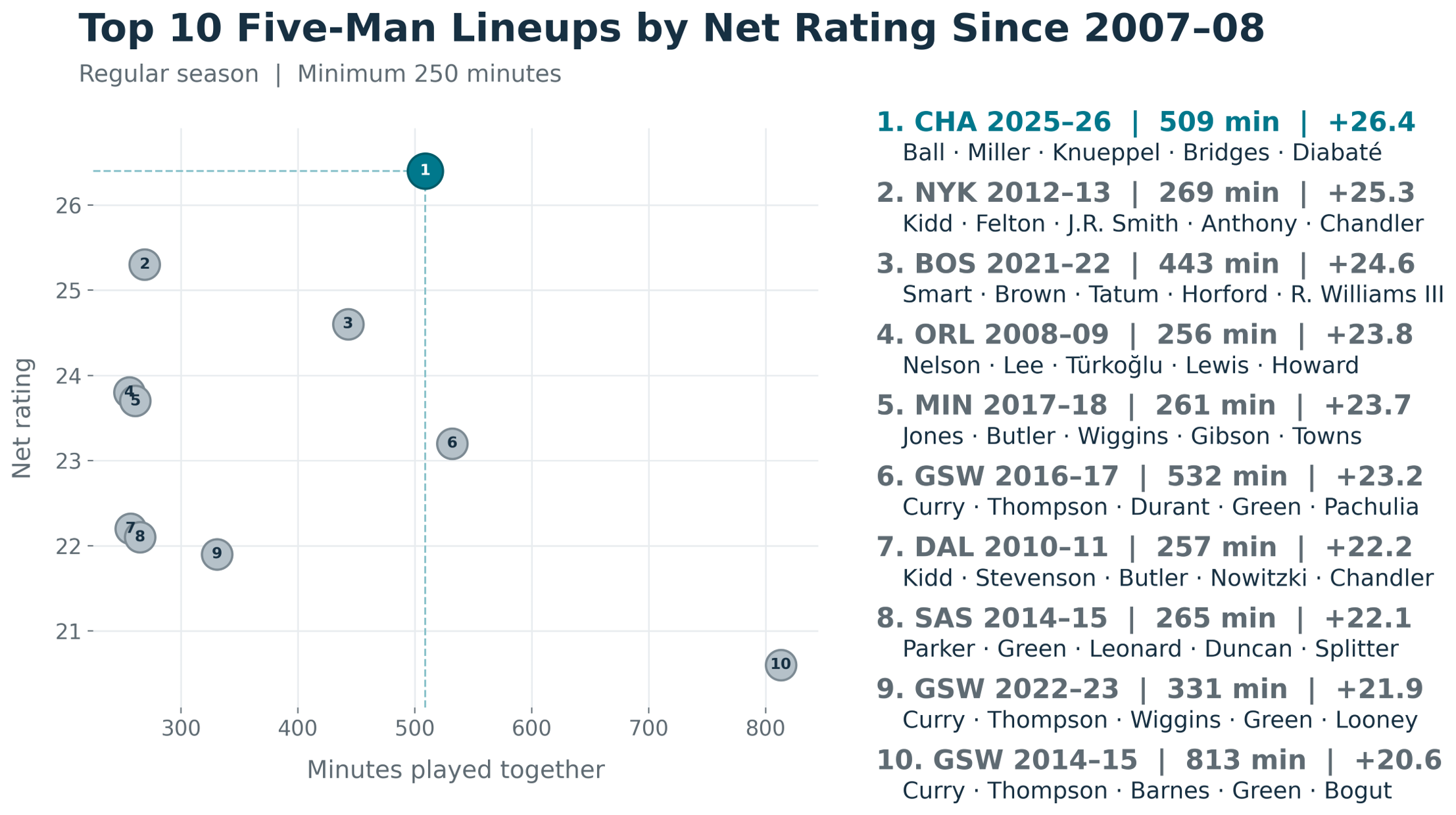
Ball, Brandon Miller, Kon Knueppel, Miles Bridges, and Moussa Diabaté posted a +26.4 net rating across 509 minutes. The graphic plots the ten historical leaders by both net rating and minutes so that shorter samples are not presented as equivalent to longer ones.
Source: NBA.com Advanced Lineups, 2007-08 through 2025-26 regular seasons, minimum 250 minutes.
No other five-man unit with at least 250 minutes across 19 seasons matched it. Charlotte’s group also carried a larger sample than seven of the other nine lineups in the graphic and finished only 23 minutes short of Golden State’s Durant-era five. However, there was still something missing.
The Gap Between a Great Lineup and a Championship Team
Among the five most-used lineups in 2025-26, Charlotte’s starting five posted a net rating 6.1 points better than the next group.
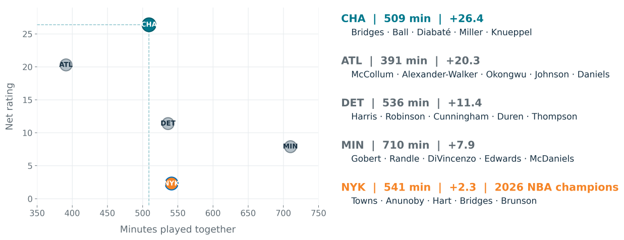
Source: NBA.com Advanced Lineups, 2025-26 regular season, minimum 250 minutes, sorted by minutes.
That dominance did not extend across the roster. Charlotte finished with a +4.9 net rating. They were behind Detroit at +8.4, Boston at +8.3 and New York at +6.4. Part of the reason for this stark contrast was that Charlotte’s offense was far worse when Ball sat. The Hornets scored 123.2 points per 100 possessions with him on the court and 110.6 without him, a 12.6-point difference. NBA.com ranked that as the third-largest offensive on/off differential among the 263 players who logged at least 1,000 minutes for one team. In The Ringer’s non-garbage-time data, Charlotte’s 123.3 offensive rating with Ball on the floor trailed only the corresponding marks for Nikola Jokić and Jamal Murray. On/off numbers are influenced by rotations and opponent quality, so the entire gap cannot be assigned to one player. They still show how little Charlotte had proved offensively without its point guard.
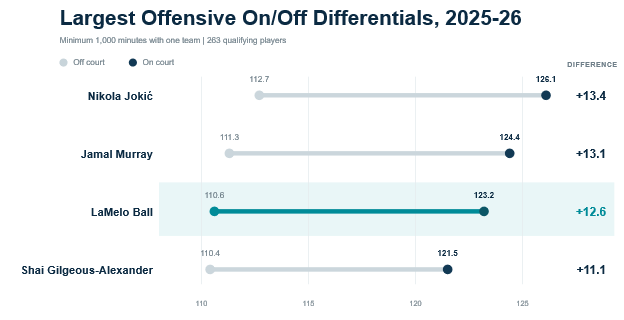
Source: NBA.com.
Ball’s 30.9 percent usage rate placed him in the 97th percentile, even though his 5.9 minutes of possession time ranked 16th in the NBA. He was heavily involved without holding the ball as long as the league’s highest-control guards.
Ball led Charlotte past Miami in its first Play-In game with 30 points, 10 assists, and the game-winning layup. Orlando then provided the clearest stress test of the Hornets’ ceiling. The Magic switched actions, used their size to crowd the driving lanes, and forced Charlotte into deliberate half-court creation in a 121-90 elimination. It was Charlotte’s third lopsided Play-In exit of the Ball era.
One game should not outweigh a 44-win season, but the matchup exposed how quickly the offense could stall against the physicality and defensive scrutiny that Charlotte would have to overcome to advance in the East.
A Healthy Season Opened a Trade Window That Might Not Last
Ball appeared in 72 games in 2025-26, restoring his trade value after years of medical uncertainty. ESPN’s Tim MacMahon said that the near consensus among executives he contacted was that Ball had next to no value a year earlier. By June, the Hornets had multiple significant offers without actively shopping him.
Ball played 36, 22, and 47 games over the previous three seasons before appearing in 72 games last season. In 69 starts last season, he averaged 28.0 minutes, ranked last among the chart’s 22 point guards with at least 48 starts, and never exceeded 37 minutes. Charlotte finally got a healthy season from Ball, but with one of the lightest workloads among established starting point guards.
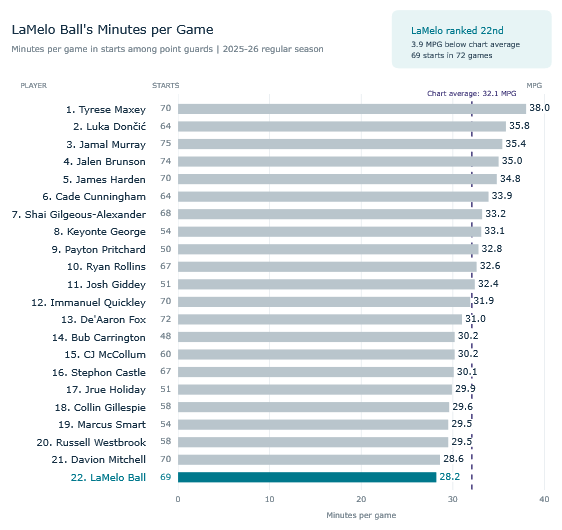
Source: StatMuse.
We do not know how much Ball’s injury risk influenced Charlotte’s decision. But the Hornets did not have to assume Ball would be injured again; they had to decide whether to keep carrying the risk after his market recovered.
One healthy season gave Charlotte a chance to trade him at what might be his market high. Before his contract became untradeable.
What was Charlotte’s Long-Term Cap Horizon with Ball?
Ball has three years remaining on his Rookie Scale Extension at 6YOS. Ball became eligible to sign a two-year Veteran Extension this summer which is currently limited to 30% of the salary cap in the first Extension year. This would be worth approximately $120,847,802 (assuming three years of modest cap growth at 5.50%).

Ball can sign this Extension up to October 19th which is the day before the start of the 2026-27 Regular Season.
However, if Ball were to make one of the All-NBA teams or be named MVP in 2026-27, where he would be 7YOS eligible, then he would be eligible for the supermax Extension which could start up to 35.00% in 2029-30 and be worth $303,668,837 over four seasons.

If he were to become supermax eligible after 2027-28, then he would be 8YOS eligible and he could sign a five-year Extension worth $393,142,691.

Ball meeting the Higher Max Criteria in the next two seasons may seem like a stretch, but he did receive five votes for the All-NBA third team this season. If his health and development continue on the right path, there is a world where he leaps the six spots needed into the third team and becomes eligible. Charlotte would certainly celebrate their first All-NBA player since Kemba Walker, but the designation would leave the team with two difficult options:
Extend Ball at 35% of the cap for one of the two contracts listed above; or
Attempt to get even a shade less than that and risk upsetting him to the point of no return.
Whether eligible for 30% or 35%, Ball would likely expect the max either way. However, even if Ball were to make an All-NBA third team, is he worth the salary cap opportunity cost that comes with that figure? Will he overcome the limitations and setbacks explored throughout this article to justify that price tag? Under the current CBA, (most specifically the cap exceptions and the Luxury Tax rates), no more than seven to ten players justify 35% of the cap and still leave enough flexibility to field a contending roster around them.
Even if Ball were not eligible for the supermax, or if he were to sign for less than his 30% max, that contract is still extremely difficult to move in a trade. If Ball were to be moved before his Extension kicked in, the acquiring team would need to have:
Sufficient Room under the cap;
A historically-large S-TPE;
Aggregate at least ~$45M in outgoing via the E-TPE and be hard-capped at the 1st Apron;
Aggregate at least ~$45M via the A-STPE and be hard-capped at the 2nd Apron; OR
Trade one of the highest-paid players (~40-45 per season).
From a CBA perspective, either extension path would have narrowed Charlotte’s flexibility. And the possibility of Ball becoming supermax eligible in the next two offseasons certainly factored into their decision to trade him away and reset their cap momentum. Rather than extend Ball and run the risk needing to attach assets to move the contract later, the Hornets chose to cash out before that decision arrived.
The approach has precedent under the current CBA: Dallas traded Luka Dončić before his supermax eligibility, and Boston traded Jaylen Brown two seasons into his supermax extension. Both had already reached the Finals.
Charlotte avoided that path in entirety and received:
Naz Reid, who is on a great contract with $103.45M/3+1 Player remaining ($25.863M AAV, ~14.50% annually);
They generated an S-TPE worth $41,020,520;
Unprotected 2033 FRP with swaps in 2028, 29, 30; and
Second-Round Picks in 2029, 32, 33.
Trading LaMelo Ball away generated the largest trade exception in NBA history, $40,770,520 but worth up to $41,020,520 if Charlotte remains below the 1st Apron. That Exception is large enough to:
Acquire any one player outside of the 40 highest paid players; or
Acquire any combination of players up to that figure in one or more transactions with one or more teams; or
Use the exception to take on a negative-value contract in exchange for draft capital or more valuable contracts; or
Serve as a tax-relief vehicle for a luxury-tax team in desperate need for relief; or
Wait until after the 2027 Moratorium to use it in a trade, sign-and-trade, or extend-and-trade, (though doing so would hard-cap Charlotte at the first apron under the non-simultaneous season rule); or
Some combination of all the above.
That S-TPE is a rare asset that creates a midseason pathway for another team to shed up to 24.87% of the cap without taking any salary back. Charlotte could extract a premium from a high-tax team or one that desperately needs a mid-season pivot out of their position.
Charlotte will be worse on the floor, and losing Ball carries real costs for the fan base. However, from a cap perspective, we grade Charlotte’s return a B, with B+ upside depending on how the Hornets use the STPE.
Peterson’s Roster Reset
Taking the helm in 2024, Peterson inherited Ball, Miles Bridges, and most of the previous regime’s history. By mid-August, he had traded Ball, Bridges, Josh Green, and Tre Mann; extended Lee; re-signed Coby White; and acquired Reid, Grayson Allen, Royce O’Neale, Dorian Finney-Smith, Dennis Schröder, Mo Gueye, and a deep pool of future picks.
Ball also drew repeated league discipline, including $100,000 and $35,000 fines for offensive language and an obscene gesture. After Charlotte’s Play-In win over Miami, the NBA assessed his contact with Bam Adebayo as a Flagrant 2 and fined him another $60,000 for the play and postgame profanity.
Ball also settled a civil lawsuit alleging that he drove over a young fan’s foot while leaving a team event and was involved in a separate two-vehicle crash months before the trade. Police filed no charges after the crash.
The incidents brought scrutiny, but there is no public evidence Charlotte traded Ball as a disciplinary measure. Peterson praised their relationship and, after meeting with Miller and Knueppel, told them, “We believe in you guys.” He said Charlotte would not have moved Ball without confidence in what they could become. Trading Bridges days later further signaled the transfer of the franchise’s identity to Lee’s system and its two young wings.
What Charlotte Becomes Without Ball
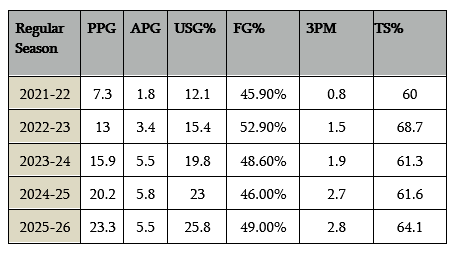
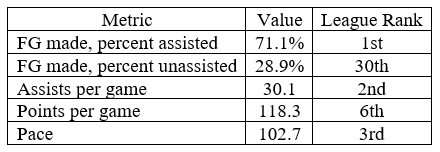
Charlotte cannot replace Ball with one player, so the more useful question is how the roster would divide his work. Brandon Miller is the clearest candidate to become the primary scorer after averaging 20.2 points and 3.3 assists while shooting 38.3 percent from three. Knueppel gives Charlotte another legitimate offensive building block alongside Miller. He finished second to Cooper Flagg in one of the closest Rookie of the Year votes in league history, averaging 18.5 points, 5.3 rebounds and 3.4 assists. He also became the first rookie to lead the NBA in made threes, setting a rookie record with 273. Ball finished second with 272, making them only the second pair of teammates to finish first and second in the league in threes in the same season, joining Stephen Curry and Klay Thompson. His role expanded further without Ball: in 10 games, Knueppel averaged 22.1 points, 6.5 rebounds and 4.2 assists. That does not make him a direct replacement for Ball’s playmaking, but it gives Charlotte considerably more confidence that a larger share of the offense can run through him. NBA.com classified 92.3 percent of his made threes as assisted, evidence that much of his elite shooting came after someone else had created the advantage.
Coby White and Dennis Schröder give Charlotte two different ways to cover the point-guard minutes. The Hornets just committed $74.000M/3 to White, a clear sign they see him as a significant part of the post-Ball backcourt. He averaged 15.6 points and 3.0 assists in 21 games for Charlotte after averaging 20.4 points and 4.5 assists for Chicago the previous season. More than half of his Charlotte field goals were unassisted, so his clearest value is self-created scoring rather than replacing Ball’s passing volume. Schröder offers a more traditional organizer and a strong depth option after averaging 10.8 points and 4.9 assists across 70 games. The Hornets just acquired him from Cleveland, making Charlotte his 12th NBA team. He can steady bench and mixed lineups while taking some of the creation burden off Miller and Knueppel, although his 32.9 percent three-point shooting carries a spacing tradeoff.
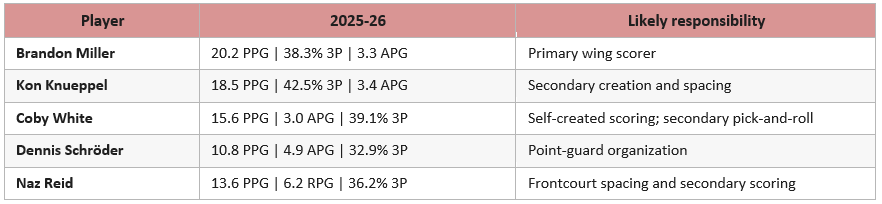
Reid changes the frontcourt rather than replacing Ball directly. He averaged 13.6 points, 6.2 rebounds, and 2.2 assists while shooting 36.2 percent from three on 5.8 attempts per game. Lining up next to Diabaté, Reid can pull a big defender away from the rim without removing Charlotte’s best rebounder and lob threat. At center, he allows the Hornets to add another guard or wing and give Miller and Knueppel more space to attack.
The roster therefore offers at least two plausible starting structures. White-Knueppel-Miller-Reid-Diabaté preserves size and frontcourt spacing, but White is its only conventional guard. Replacing Diabaté with Schröder gives Charlotte a second ballhandler and lets Reid play center, but it sacrifices size and places a 32.9 percent three-point shooter in a smaller lineup. Miller and Knueppel can absorb more scoring, White can create shots, Schröder can organize possessions, and Reid can open the floor.
Conclusion: The Bet Charlotte Made
The bet is that Reid, the Exception, and the extra draft capital can eventually produce a team with more ways to survive physical playoff basketball, or at the very least buy them the time and cap relief to design a higher ceiling - even if Charlotte is worse for the immediate future.
Minnesota can make the opposite calculation because Anthony Edwards remains their primary scorer while Jaden McDaniels and Rudy Gobert provide the necessary defensive support. Ball can join an established hierarchy there instead of being asked to define one.
The trade will be judged by whether Charlotte’s new assets produce a ceiling that its best Ball-led roster never proved it could reach.
Thank you for reading. If you have any business inquires, please reach out to:
or you can leave your information below: