
Luka, Reaves, and the Cost of Imperfect Fits
Austin Reaves has evolved from an undrafted two-way guard into one of the NBA’s more unlikely success stories, emerging this season as a near All-Star level offensive creator while averaging 23.3 points, 5.5 assists, and 63.0% true shooting for the Lakers. Between the Lakers’ second-round series against Oklahoma City, Reaves’ looming free agency, concerns surrounding his playoff scalability, and the long-term fit next to Luka Dončić – discussion surrounding his valuation has never been more critical for the Lakers’ future. The decisive question is whether his game cleanly translates to deep playoff basketball strongly enough to justify becoming one of the defining financial and stylistic commitments of the Lakers’ Luka Dončić era.
The Rise
Reaves’ rise to this point was never supposed to happen this quickly, or frankly, at all. After withdrawing from the 2021 draft process late in the second round, Reaves and his representation intentionally targeted Los Angeles, believing the Lakers offered the clearest developmental path and roster opportunity available. He signed a two-way contract following Summer League, impressed immediately during minicamp and training camp, then earned a standard NBA deal before the season began.
From there, the development curve accelerated rapidly. Reaves evolved from a low-usage connector into one of the Lakers’ primary offensive engines, steadily increasing both his on-ball responsibility and production every season while maintaining strong efficiency alongside LeBron James.
Regular Season Development
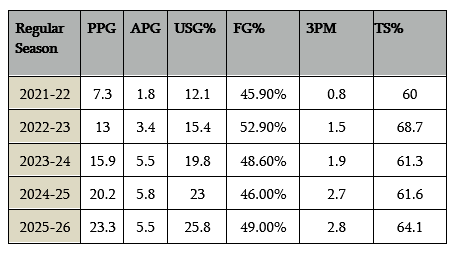
The underlying scoring profile demonstrates a unique offensive threat. Only 31.8% of Reaves’ two-point field goals were assisted during the regular season, meaning most of his half-court offense was self-created. However, at the same time, over 70% of his three-pointers were assisted, allowing him to function effectively both on and off the ball next to another dominant initiator like Dončić. This complementary duo was incredibly effective in the 2025-26 regular season, outscoring opponents by 8.6 points per 100 possessions in 1091 minutes played. The 2025-26 regular season was strong evidence that a Luka-Reaves backcourt can thrive. However, the postseason is where his evaluation becomes significantly more complicated.
The Playoff Conversation
Reaves’ playoff scoring has remained relatively stable throughout his career, but the efficiency decline under postseason pressure has been dramatic. It is clear that the heightened scrutiny of playoff basketball consistently suppresses Reaves’ offensive impact. His field goal percentage, three-point percentage, and true shooting percentage have all dropped sharply every postseason once defenses game-plan for him over a series. The 2026 postseason and absence of Luka also raised concerns about ball security as his offensive burden expanded deeper into primary creator territory.
The statistical drop-offs are not necessarily catastrophic, but they are noticeable enough to consistently fuel discussion surrounding his long-term ceiling as a primary playoff creator.
Efficiency Decline Under Playoff Pressure
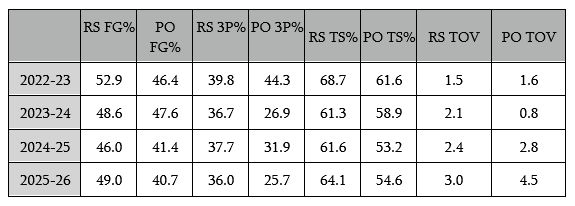
Reaves wins offensively with craft, pacing, deceleration, contact manipulation, changes of speed, and body control to get defenders off balance, draw fouls, and create advantages without an overwhelming first step or elite athleticism. However, once a player becomes the primary focus of a scouting report over a seven-game series, driving lanes shrink, help rotations tighten, and point-of-attack defenders become significantly more physical possession-to-possession. As a result, the lack of elite separation becomes more pronounced, particularly against defenses built around length and perimeter athleticism, something Minnesota particularly Jaden McDaniels’ last postseason, and Oklahoma City this year have consistently focused on.
Lakers Offensive Rating Decline
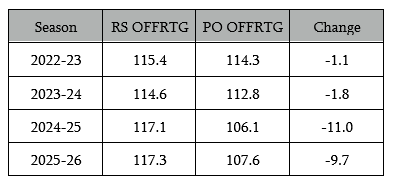
Over the last two postseasons alone, the Lakers’ offensive rating with Reaves on the floor dropped roughly ten points compared to their regular season marks each year.
Defensive Rating Deterioration
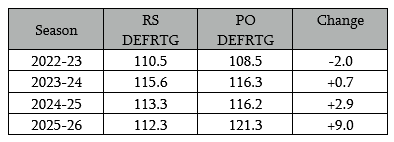
Simultaneously, the defensive side of the equation has progressively worsened as playoff opponents increasingly target Reaves at the point of attack, isolating him, and forcing the Lakers into secondary rotations earlier and more often.
Overall Net Rating Impact
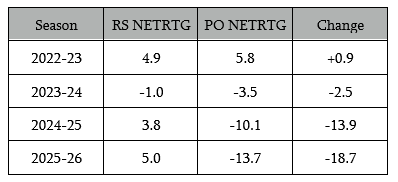
What began as a highly positive playoff impact profile in 2022-23 progressively deteriorated as Reaves’ offensive responsibility expanded deeper into primary creator territory. Over the last two postseasons alone, the Lakers’ net rating with Reaves on the floor swung nearly 14 points and then nearly 19 points compared to his regular season impact. The concern is not whether Reaves is a talented offensive player. It is whether a team can consistently survive four playoff rounds with one of its primary creators becoming a defensive exploitation while facing more physical halfcourt creation demands against elite postseason defenses.
The Luka Fit
The playoff concerns surrounding Reaves become even more significant once we consider the value of Luka Dončić. There is clear overlap between the two offensively. Both prefer playing with the ball in their hands, controlling pace, and creating offense through manipulation. While they may be able to complement each other offensively in the regular season - the overlap in their strengths and weaknesses demands questions about the long-term fit as Reaves’ enters unrestricted free agency.
Ideally, a team’s two highest-paid players complement one another by covering for the other’s weaknesses. In this scenario, many of the same concerns exist for both players, naturally creating a smaller margin for error when constructing a roster around them. The concerns become less significant offensively, where both are clearly talented enough to coexist, and far more significant on the defensive end, where playoff basketball relentlessly targets physical limitations, matchup weaknesses, and perimeter vulnerability over the course of a series.
Following this year’s elimination, multiple reports indicated Dončić strongly values continuing to play alongside Reaves long term, a sentiment Luka publicly echoed when discussing the chemistry and offensive burden-sharing the two developed throughout the season.
The Roster Construction Problem
Overlapping strengths and weaknesses between your two highest paid players does not necessarily limit a team’s potential. Luka and Kyrie Irving faced many of the same concerns before ultimately reaching the 2024 Finals together in Dallas. The difference from the current Lakers construction was the roster that Dallas built around them. Dallas’ overall length, athleticism, rim protection, and defensive versatility (most notably in Derrick Jones Jr., P.J. Washington, Daniel Gafford, Dereck Lively II) consistently covered many of the defensive and athletic limitations within the Luka-Kyrie pairing itself. After acquiring Washington and Gafford at the trade deadline, Dallas jumped from 22nd in defensive rating to 7th while finishing first in opponent field goal percentage at the rim. That supporting infrastructure allowed Dallas to survive defensively while still maximizing the offensive strengths of its primary creators.
There are also creative lineup possibilities the Lakers could explore moving forward. In certain playoff environments, staggering Reaves more aggressively into bench-heavy units could allow him to function in a role more similar to Manu Ginóbili’s in San Antonio: operating as a primary creator against secondary defensive units while still closing games alongside the team’s stars.
If Los Angeles fully commits to a Luka Dončić-Austin Reaves backcourt long term, they are effectively betting they can build a roster capable of covering many of the weaknesses that naturally come with the pairing. That means surrounding them with enough defensive infrastructure, size, rim protection, and athletic versatility to survive deep playoff basketball. In many ways, Reaves’ eventual contract value is tied directly to whether the Lakers believe that version of roster construction is realistically attainable throughout the Luka Dončić era. More than anything, the situation highlights the balancing act facing the Lakers moving forward. In a Western Conference loaded with teams like Oklahoma City, Minnesota, and San Antonio, all built around size, athleticism, versatility, and depth, Los Angeles would realistically need to nail almost every major roster decision around Dončić and Reaves to sustain championship-level basketball. If the organization ultimately decides that becomes too difficult at Reaves’ future price point, the conversation naturally shifts toward the financial tradeoffs, roster-building alternatives, and cap flexibility pathways available under the modern CBA.
How does this translate to Reaves’ market value?
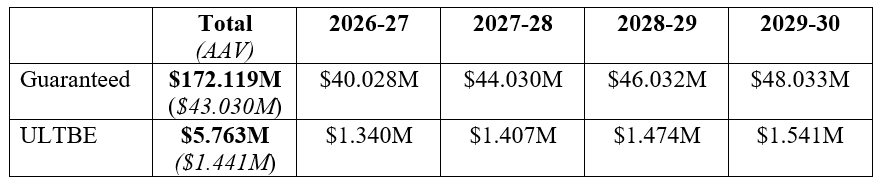
Opposing clubs who favor Reaves’ regular season production could easily find themselves looking at Desmond Bane’s near-max Restricted Free Agency deal. Bane’s platform regular season was remarkably similar to Reave’s.

Bane’s deal was for 24.19% of the cap, with the remaining 0.81% in unlikely bonuses. Under the 2026-27 cap, Reaves structure would look like:
Opposing clubs who give more weight towards Reaves’ postseason challenges and defensive limitations might find themselves closer to Tyler Herro’s 4-year Rookie Extension, or Jordan Poole’s 4-year Rookie Extension.

Herro and Poole’s contracts would look like the following in 2026-27:
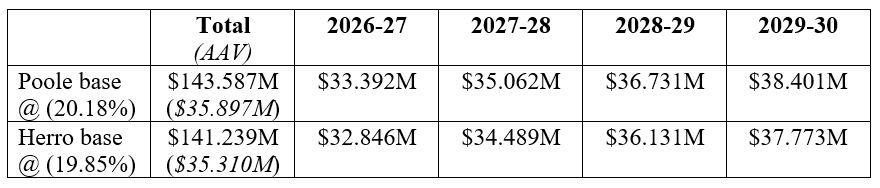
Valuation Conclusion: Reaves fair market value is likely somewhere between 21% - 24% of the cap.
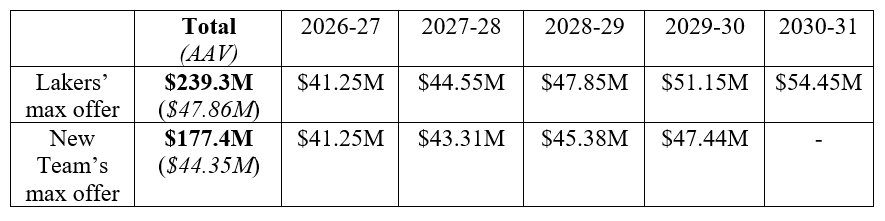
Below is the max Reaves could receive.
What realistic threats do the Lakers face?
Assuming that Reaves declines his $14.899M Player Option for 2026-27, there are only three realistic mechanics for Reaves’ next contract:
1. Lakers re-sign using Bird Rights;
2. New Team signs via Room; OR
3. New Team signs via a Sign-and-Trade.
While the Lakers could offer him the largest and/or longest contract, the limitations laid out above present clear issues with offering Reaves a max – thus locking up to ~55% of the Lakers’ cap, just between him and Luka for the next three seasons. A competitive roster with this large of a commitment would almost certainly have the Lakers flirting with the First Apron starting this summer, which drastically reduces the number of ‘outs’ available to continue upgrading the roster. Effective price discovery of Reaves this summer will come down to what kinds of offers Reaves can generate externally. Assuming that Chicago or Brooklyn do not field an offer using Room, the only viable option that does not require significant additional moves would be a Sign-and-Trade.
Many names have been floated around as potential Reaves Sign-and-Trades; however, we feel that only a few moves are mutually beneficial enough for LA to even consider given Luka’s clear stance on retaining Reaves. The most credible partners share a profile: clubs with enough cap flexibility to absorb a ~22.5% cap hit, a credible win-now timeline in need of an offensive injection, and a return asset that complements Luka well. Please check back next week when we break down Jalen Duren’s Restricted Free Agency and why Detroit may fit that profile better than anyone.
In conclusion, Reaves is a phenomenal offensive talent. But his playoff struggles and overlapping strengths and weaknesses with Luka Dončić make his valuation ahead of free agency quite challenging. However, given Luka’s clear stance on retaining Reaves, in conjunction with few realistic suitors under the CBA - Reaves re-signing in LA for ~22.5% remains the most likely option. Given some of the concerns addressed in this article, we would also not be surprised to see a max trade kicker included in the final deal - especially as that annual cap hit rises and with it, expectations.