
When Sellers Buy: Utah’s Case for Jaren Jackson Jr.
When the notification from Shams Charania popped up on my phone, my first reaction was utter confusion. Utah sending three first-round picks for Jaren Jackson Jr. did not line up with the version of the Jazz I thought I was watching. A 16–36 team with multiple bigs does not usually consolidate assets that aggressively.
However, the more I dug into Utah’s season, the less the move felt rushed. The explanation starts with the numbers.
Utah Jazz Offensive Profile Indicators
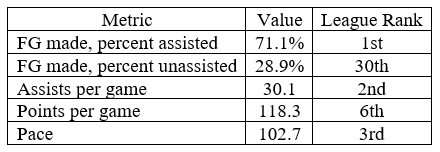
Utah’s offense is built on flow, tempo, and ball movement. They rank second in assists per game at 30.1, trailing only the Atlanta Hawks, whose ball movement I examined in detail in my last piece. That passing volume shows up everywhere in Utah’s profile. The Jazz lead the league in assisted field goals and rank last in unassisted makes, confirming that their scoring is generated through movement rather than individual creation. Playing this fast and sharing the ball at this level narrows the margin for error defensively.
An offense built on pace and connectivity demands a reliable backline defense to survive.
The Defensive Breakdown
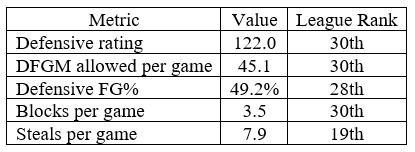
Defensive resistance has not been there. The Utah Jazz rank dead last in defensive rating at 122.0, nearly three full points worse than the Washington Wizards at 119.9. Supporting indicators tell the same story. Utah allows a league-worst 45.1 defensive field goals made per game, ranks third worst in defensive field goal percentage at roughly 49.2 percent, sits 19th in steals, and ranks last in blocks at just 3.5 per game.
Utah Jazz Shot Contest Split
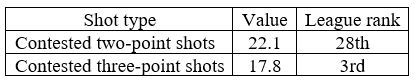
Hustle and contest data sharpen the diagnosis. Utah sits in the lower quartile in defensive deflections and defensive loose balls recovered, ranks third worst in contesting two-point attempts, yet sits third best in contesting shots beyond the arc. The split is revealing. Perimeter pressure exists, but interior resistance consistently breaks down, leaving the rim exposed and possessions unfinished. With an offense already functioning and guards holding up on the perimeter, Jackson directly targets the one area Utah has been unable to stabilize.
Understanding the Fit
One important layer of context sits beneath Utah’s defensive profile this season. Much of the Jazz’s interior defensive data came without Walker Kessler on the floor. Since entering the league, Kessler has averaged 2.4 blocks per game over his career, establishing him as a consistent rim deterrent. His absence materially altered Utah’s defensive shape. Last season, Utah posted a defensive rating of approximately 120.4, already below league average but still structurally functional. This season, that figure ballooned into the 123 range, worst in the league. On smaller on-off samples, Utah’s defensive rating improves meaningfully with Kessler on the floor, reinforcing that the collapse was driven more by missing personnel than by scheme.
At the same time, the offensive side of the profile flipped. In 2024–25, Utah’s offensive rating hovered around 110, placing them in the bottom third of the league. In 2025–26, that number jumped into the mid-115 range, reflecting gains in pace, ball movement, and scoring efficiency. Utah solved offense first. The cost was defensive stability.
That sequencing is why Jackson became the answer. Utah is not attempting to rebuild its defense from scratch. It is attempting to restore it while preserving the offensive gains already made. Utah’s frontcourt allows Jaren Jackson Jr., a former NBA Defensive Player of the Year, to operate in the role where his impact has always been strongest. Lauri Markkanen provides size and spacing, Walker Kessler anchors the rim and absorbs rebounding responsibility, and Jackson fits between them as a switchable help defender and floor spacer. His rebounding limitations, reflected in his 5.8 rebounds per game, are no longer a structural issue in a lineup designed to absorb them.
That construction was intentional. Utah declined multiple first-round picks from Indiana in discussions involving Kessler, signaling that he was never treated as expendable draft currency. With Kessler returning and Jackson added, Utah is stacking interior deterrence rather than hoping one player fixes everything. The roster now allows for true flexibility: big lineups featuring all three, or smaller units with Jackson at the five and Markkanen at the four without sacrificing rim protection or spacing. Utah already has the offense it wants. The bet is that the defensive structure now holds.
Keyonte George: Year-over-Year Growth
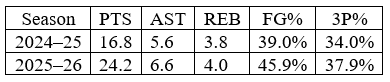
One of the clearest signals pushing Utah toward action has been the development of Keyonte George. Recent stretches, including multiple 30-plus point games and a career-high 43, have shifted how the Jazz are treating him internally. This no longer looks like a guard being brought along patiently. That kind of growth changes the timeline, whether a team announces it or not.
Draft Capital Context
First-round picks Utah traded for Jaren Jackson Jr.:
2027 first-round pick via the Los Angeles Lakers
2027 first-round pick (Utah’s own)
2031 first-round pick via the Phoenix Suns
Draft picks Utah still controls going forward:
Own picks: All future Utah first-round picks except 2027. Utah’s 2026 first-round pick remains protected and projects as a high lottery selection in a draft widely viewed as elite.
Non-own first: 2031 via Phoenix
Swap-based upside: 2026, 2028, 2029 (Cleveland / Minnesota structures)
Two of the three first-rounders sent out were acquired from other teams, and the only original first-round pick Utah moved was its 2027 selection. The Jazz preserved their most immediate lottery equity while converting surplus future assets into a defined and established defensive piece.
Rethinking the Buyer–Seller Binary
At first, the trade felt like Utah moving faster than its record suggested it should, the kind of decision usually reserved for teams that have already clarified their direction. But the more time you spend with Utah’s season, the clearer it becomes that this move was not driven by impatience so much as recognition. Adding Jaren Jackson Jr. does not suddenly turn Utah into a finished product, but it removes the one constraint that repeatedly capped everything else they were building. The offense is defined and the young core development is real. The remaining question was whether that structure could be defended at the rim and sustained across lineups. This trade answers that question directly. Utah didn’t move early; it moved once the front office understood the roster limitations and was ready to consolidate future assets for a former Defensive Player of the Year.