
Cornered between two Aprons - Watson’s RFA Case
Through his first three NBA seasons, Peyton Watson was a highly intriguing defensive wing whose offensive game carried major questions. Then, injuries this season pushed him into consistent starter-level responsibility, and his evaluation around the league changed quickly.
The question now is whether that late-season offensive growth was real enough for another team to take an aggressive bet on him entering Restricted Free Agency. The timing could hardly be worse for Denver, whose financial flexibility has all but disappeared under the 2nd Apron.
The Undeniable Defensive Value
With a 6’8” frame, a 9’ standing reach, elite recovery speed, and uncommon mobility for his size, Watson already fit one of the league’s most valuable defensive molds long before the offense started catching up. Denver trusted his defensive output early. Few wings impact possessions the way Watson does. He can switch across positions, defend at the point of attack, rotate as a weakside helper, and still recover out to shooters. During the 2023-24 season, opponents shot just 50.5% at the rim against Watson, the second-best mark in the NBA among players defending at least 200 shots. Only Ivica Zubac, a 7’0” center, protected the basket better. Watson also held his matchups to 42.4% shooting overall, ranking third among the 264 players who contested at least 400 field goals.
Watson led Denver in blocks in each of the last three seasons. During the 2024-25 season, he finished 16th in the NBA with 93 total blocks; only Isaiah Stewart recorded more blocks among players 6’10” or shorter. Watson also led the NBA in blocked three-pointers with 17 that season.
The uncertainty with his game was always the offense.
Watson generated value through activity, transition play, cutting, and connective offense, but halfcourt possessions could still break down once defenses forced him beyond quick decisions or. Earlier in his career, he looked far more comfortable playing off advantages than creating offense himself.
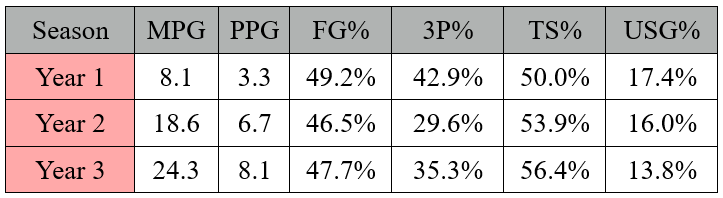
For most teams, Watson’s profile through three seasons would not justify starter-level money. The valuation would probably hover around the Non-Taxpayer Mid-Level Exception, which projects to be $15.048M in 2026-27. However, that changed once Denver started placing real offensive responsibility on him this season.
Starter vs Bench Role in 2025-2026
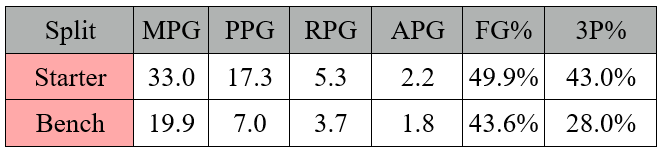
Once Watson entered the starting lineup, his scoring nearly doubled without sacrificing the defensive impact he already provided. The context matters. Developing offensive rhythm next to Nikola Jokic and Jamal Murray can be difficult because so much of Denver’s offense naturally flows through them. Watson’s breakout stretch largely arrived when injuries forced Denver to place far more offensive responsibility on his shoulders, including during Jokic’s 16-game absence in January. During one four-game stretch, he earned his first Western Conference Player of the Week award - averaging 24.5 points, 8.0 rebounds, 4.0 assists, 1.3 steals, and 1.8 blocks while shooting 50% from the field and 70% from three. Instead of looking overwhelmed by the expanded role, Watson averaged more than 22 points per game without Jokic and didn't sacrifice anything defensively.
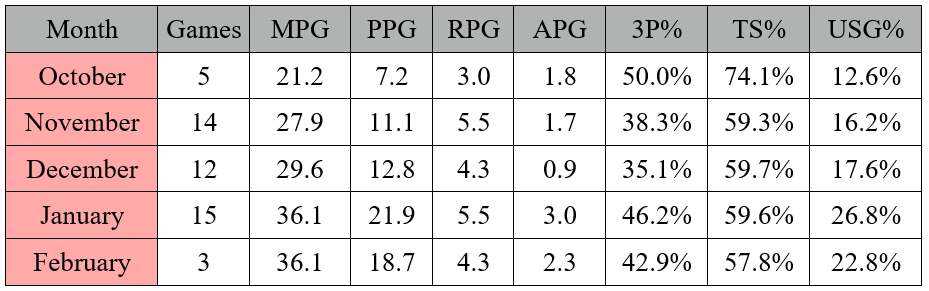
The scoring jump in January and February was clearly significant, but the more important shift was how the offense held together under larger responsibility. Plenty of athletic role players can survive in smaller, more passive offensive roles with less defensive focus. Things look very different once those same players start seeing real starter minutes against loaded halfcourt defenses where weak decision-making gets exposed.
Watson handled that environment far better than expected. The closeout attacks became controlled and more deliberate. Possessions that previously stalled started flowing naturally into second and third reads. Earlier in his career, those same possessions often became rushed once defenses sped up his decision making or forced him deeper into the clock. During that winter stretch, he started looking far more comfortable operating through those sequences instead of simply reacting to them.
The production jump may not have been as sudden as it initially appeared. Back in 2023-24, Watson became the first player in NBA history to record at least 80 blocks, 40 steals, and 40 made threes while averaging 20 or fewer minutes per game. Even in a limited role, the underlying defensive activity and per-minute production were already highly unusual. The offensive breakout may have ultimately been as much about expanded opportunity as development itself.
The shooting growth may have been the most important offensive development of all. Watson converted 46.8 percent of his catch-and-shoot threes during the 2025-26 season, the 4th-best mark in the NBA, while also shooting 51.8% on corner threes, which was 9th-best in the league.
Market Comparisons
For a player whose defensive versatility was already established, this season’s offensive output might place him in a premium market ahead of Restricted Free Agency. A long, switchable wing who shoots the ball credibly does not need to reach his ceiling to justify a significant commitment; he just needs to be reliable on both ends of the ball in the right moments against the right matchups in May. The supply of players who fit that description at the playoff level is narrow enough that teams price in the projection.
Market High – The Platform Season
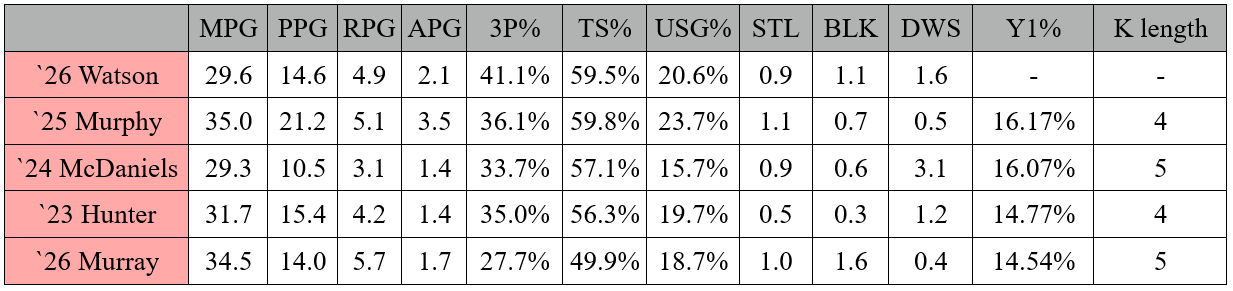
These four long, athletic wings were selected due to their defensive impact and secondary offensive roles. Trey Murphy was not quite the same defender as the rest of this pool at this stage, but his offensive role was much more significant and his 16.17% is a solid market high for Watson’s offensive production.
Watson’s platform season is well situated around the middle of this selected market pool. His counting stats all hover around the middle of the pack but his efficiency and usage stand out.
The simple average of these four players is 15.39%.
Market Floor – Career Production
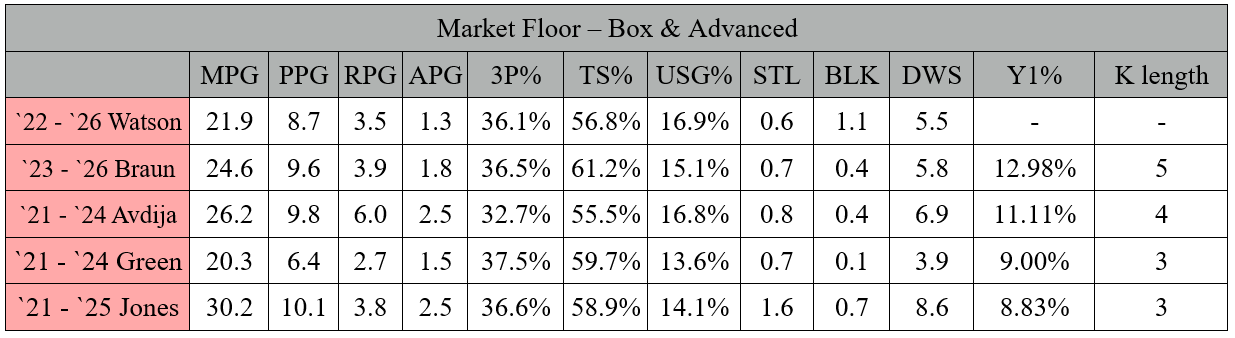
These four perimeter players were selected due to their comparable production through their first four seasons.
Watson’s career production is well situated around the bottom half of this selected market pool. His counting stats and efficiency are all in the bottom half.
The simple average of these four players is 10.48%.
However, this market pool compares Watson to three players who started and played significantly more minutes through their first four seasons. It is difficult to compare raw counting stats when Watson was a developing reserve for a Finals caliber team.
Thus, production per 36 of the same market offers a grounded market middle.
Market Middle - Career Production per 36
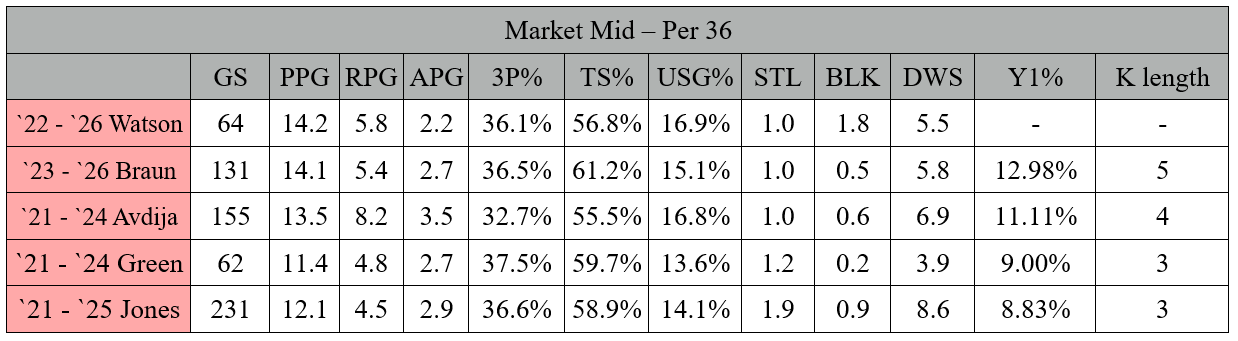
This is the same four players adjusted per 36.
Watson’s counting stats are quite strong and he is either leading or in the top half of all but assists and steals.
Market Valuation Conclusion
We looked at eight players and applied three different analytical frameworks.
The market-high judged Watson’s platform year, where the average was 15.39%.
The market-middle judged Watson’s career production per 36, where he generally led the pool at 12.98%
The market-low judged Watson’s raw career production, where he was around the middle at 10.48%
The Y1% simple average of all eight market comps is 12.93% ($21.396M in 2026-27).
While Watson’s platform season was extremely impressive, it also represents a small sample size of what he has produced and it is difficult to justify placing him above 14.75%. On the low end, given the remarkably similar career production with Braun – who received an extension from the same team – the floor is probably 12.98%.
The fair market valuation range is likely within the 12.98% - 14.75% range, with a number around 13.75% ($22.688M in 2026-27) representing both the small sample size and potential upside.
That contract with Bird and non-Bird Rights is below:

The Bird Rights would look as follows on Denver’s sheet as of July 1:
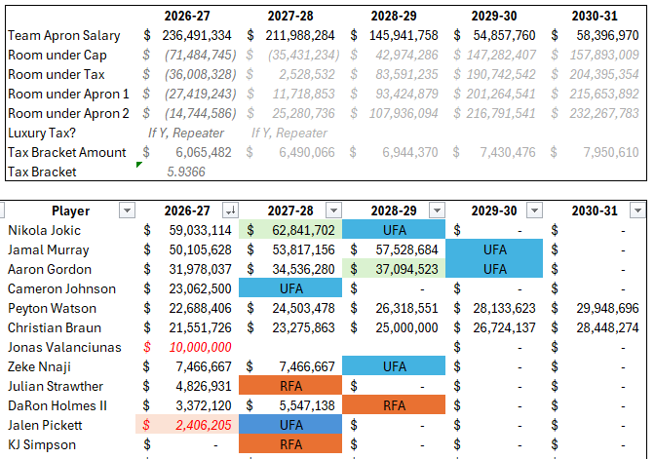
Assuming no other moves, Watson at his fair market value would receive the 11th roster spot on a Denver payroll that would be $71.485M over the cap, $36.008M over the tax, and $14.745M over the 2nd Apron. Not only does roster construction become incredibly difficult above the 2nd Apron - the projected tax bill alone for this position would be $200.213M, which is almost four times greater than the cumulative tax Denver has paid in the last two decades. While Denver has been willing to pay modestly into the tax during this historic run from Jokic, the Nuggets likely cannot retain Watson at market value without moving salary elsewhere on the roster, especially after a first-round playoff exit and public comments from the front office suggesting nearly everything besides Nikola Jokic is on the table.
A note on the 2nd Apron
The sheet above assumes Denver makes no moves before signing Watson, where they are currently $2.580M under the 2nd Apron. Avoiding any hard cap triggers before signing Watson is crucial ahead of the RFA Game, which we will explore in the next section. Triggering a hard-cap before signing Watson would effectively bar Denver from exercising their Right of First Refusal as they would no longer be able to exceed the respective apron under any circumstances. Their only avenue to match Watson would be using the matching window to dump salary which would be very difficult and leveraged given the implications.
While there is nothing hindering Denver from signing or matching Watson, exceeding the 2nd Apron, and then figuring out how to shed salary – Denver has the entire Moratorium Period to negotiate trades and line up moves to execute after the Moratorium ends, before RFA effectively ‘begins,’ and they should/will take full advantage of that period to get their cap sheet in order.
The only mechanic that matches all these needs, limitations, and considerations is the Standard Traded Player Exception, which would not trigger any hard cap (if fully exercised within the season).
Utilizing the S-TPE, Denver will likely execute a series of individual trades, likely sending out some of the following individual players:
Cam Johnson ($23.063M; expiring)
Christian Braun ($21.552M; no longer poison pilled, in year 1 of a $125M/5 year extension)
Jonas Valanciunas ($10.000M; expiring and only $2.000M guaranteed - can be traded for a Minimum, saving Denver ~$7.75M and the other team $300k)
The other club can utilize one of the following mechanics to absorb salary:
Room, triggering no aprons;
Standard TPE of their own, triggering no aprons;
Expanded TPE, triggering 1st Apron hard cap;
Aggregated Standard TPE, triggering 2nd Apron hard cap.
In return, Denver receives:
Rotation player(s); whom
ideally, make less money in aggregate so that Denver can retain Watson without entering the 2nd Apron.
We are venturing outside the scope of this article, but a final thought: if Denver could only make one move before Watson’s RFA game, the ideal trade from a salary cap perspective would likely be sending Braun plus draft capital away in return for two to three low-rotation players on Minimum deals from a Room/existing TPE team. Denver could also trade one of their guys in return for solely draft capital, then package that capital into another salary dump to generate two separate S-TPEs and significant Apron and Tax relief.
However, if Denver is unable to shed any salary, then they will be leveraged into a very difficult corner within the CBA.
The RFA Game
Denver’s inevitable Repeater Tax status is the greatest leverage point Watson and a New Team have at their disposal. Increasing the likelihood that Denver will not match an Offer Sheet will come down to how much an Offer Sheet impacts Denver’s Team Apron Salary and Team Tax Salary for the next two seasons. This can be achieved via a front-loaded contract with max 5% declines.
A matrix displaying the Y1 value and the projected tax bill (assuming Denver makes zero moves before Watson receives an Offer Sheet) is as follows:
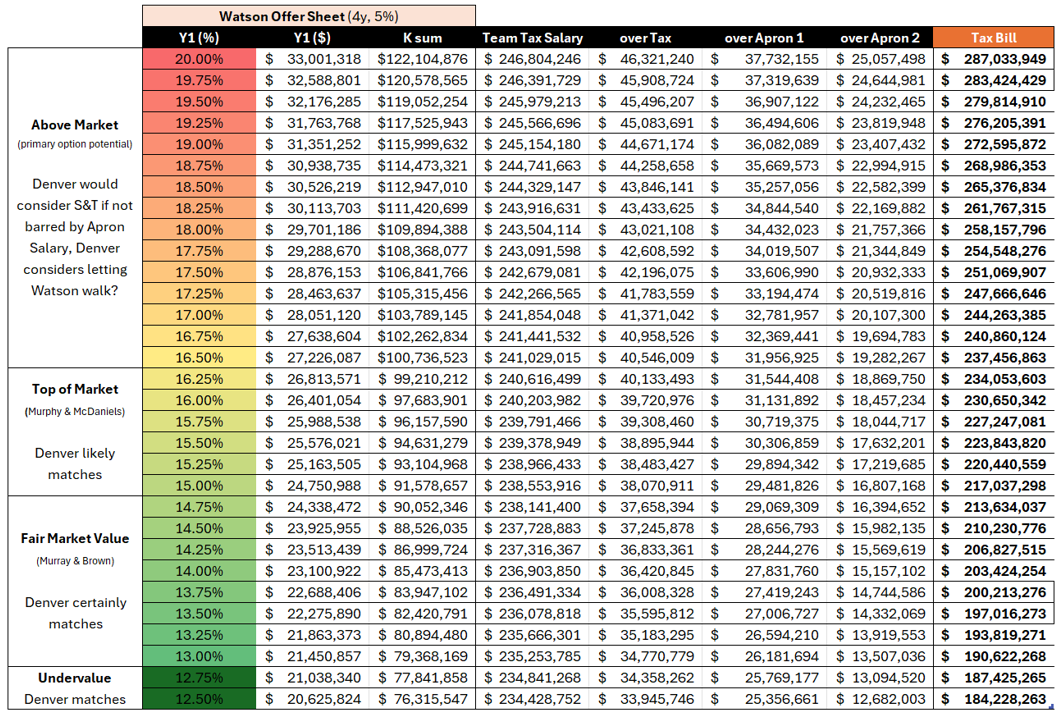
Compared to a back-loaded contract of the same sum, a front-loaded contract with max 5% decreases could increase Denver’s 2026-27 Tax Bill around $30M. For example:
the non-Bird market valuation was $97.560M/4, starting at 13.75%. Projected 2027 tax bill: $200.213M.
If we front-load a guaranteed sum of $97.684M/4, which starts at 16.00%, the projected 2027 tax bill soars to $230.650M.
Now – as you can see from our market valuation on the far left of the matrix (plus our anecdotal comments), prying Watson off of Denver’s leveraged hands would likely require an Offer Sheet which starts around 17.50% or higher. While that Offer Sheet is over 3% higher than our valuation, the delta contains the premium necessary for that RFOR, additionally the total guaranteed sum is only $9.281M greater than the market value sum. A ~$10M premium is a small price to pay for a talent like Watson. The declining structure also benefits any club’s long-term planning – Denver this summer aside.
An Offer Sheet can also contain up to: 10% in Signing Bonus, 15% in Trade Kicker, and 20% in Incentive Compensation. While the Principal Terms of an Offer Sheet exclude Unlikely Bonuses (which would further hamper Denver’s mobility to navigate under the Apron without converting into Team Salary/remitted salary), a New Team could allocate the Incentive Compensation towards “Generally Recognized League Honors.” A New Team could also tack on a Player Option in the fourth season, offering Watson the opportunity to get back on the market with seven Years of Service in 2029 where the cap could be ~20%+ higher.
Below is what a 4-year declining offer with maximum 20% bonuses would look like:

This contract structure should be understood as a very aggressive bet on a half-season flash of brilliance. However, it is all theoretically possible under the CBA. And a highly-interested club would leverage some, or all, of these principles if prying Watson away from Denver was their offseason priority.
Assessing Threats
The only teams with more than $33M Room this offseason are most likely confined to:
Chicago: ~$70M
Brooklyn: ~$42M
Los Angeles: ~$58M (if Lebron James’ $59.5M cap hold is renounced)
Both Chicago and Brooklyn would be natural landing spots for Watson. He would join younger rosters with longer competitive timelines and have significantly more opportunity to explore the offensive growth he displayed during Denver’s injury-riddled stretch. Beyond the available cap space, both organizations are in positions where betting aggressively on upside makes far more sense than it does for a win-now contender. Chicago enters the offseason with a new front office, a coaching change, and one of the cleanest cap sheets in the league. Brooklyn similarly has significant flexibility and added incentive to accelerate its timeline. With the Knicks currently in the NBA Finals and dominating the attention of the New York basketball market, the Nets face increasing pressure to put a competitive and credible product on the floor. Watson's age, defensive versatility, and flashes of offensive growth align naturally with both timelines. Unlike Denver, where much of the offense naturally flows through Nikola Jokic and Jamal Murray, each organization could offer the touches and developmental runway necessary to determine whether early 2026 was merely a flash or a legitimate glimpse of his long-term ceiling.
Los Angeles would allow Watson to join Luka Doncic and potentially Austin Reaves, creating one of the stronger wing groups in the Western Conference. Watson would likely see very few opportunities as a primary or even secondary initiator alongside two established creators, but his skill set would complement Luka very well. Doncic-led teams have historically thrived when surrounded by long, athletic wings who can defend multiple positions while providing enough shooting to keep the floor spaced. Derrick Jones Jr. became a key part of Dallas’ Finals run because his length, athleticism, and defensive versatility helped absorb difficult defensive assignments around Luka. Watson offers a similar defensive foundation with greater weakside rim protection and more offensive upside. If his shooting growth proves sustainable, he projects as exactly the type of high-level 3-and-D wing teams spend years trying to place next to a heliocentric superstar. However, this scenario would most likely require the Lakers to renounce LeBron James’ cap hold, which probably only becomes realistic if LeBron has already decided to leave. LeBron and Watson are also both represented by Klutch Sports.
Denver's financial situation all but guarantees major roster decisions this summer. After a disappointing first-round exit, Nuggets owner Stan Kroenke closed the season by saying that everything is on the table except Nikola Jokic. The Nuggets must now decide whether Watson's offensive growth is worth the financial sacrifices required to keep him, and whether betting on his continued development is part of the path toward extending their championship window. Meanwhile, the rest of the league may be willing to pay for the possibility that those final two months revealed one of the NBA's most valuable player archetypes. How those competing valuations ultimately collide may become one of the defining storylines of the summer, defining Denver’s championship window and shaping the rest of the Western Conference.
Conclusion
Watson’s Fair Market Value is around 13.75%. Pricing Denver’s match out of the equation involves many factors, but would probably become a real discussion point around 16.50% due to Denver’s Apron and Tax Salary.
What to watch for this Moratorium Period:
If Denver’s ownership is willing to pay a deep tax bill = Denver retains Watson
Denver trades Valanciunas for a minimum to a team who waives him = likely and will reduce the Apron and Tax Salary; more likely that Denver retains Watson
Chicago and/or Brooklyn use most of their Room = Denver likely retains Watson around ~13.75% - 14.75%.
LeBron signs with another club (or signs with LA at the NT-MLE) and Los Angeles prioritizes Watson Offer Sheet = Offer Sheet would likely be front-loaded with max declines, Y1 likely greater than 16.5% - ideally around 18.75% - 19.00%. Maybe an aggressive bonus structure, maybe even a Player Option.
Thank you for reading. For business inquiries please reach out at:
contact@ponsports.com
Or leave your information below.