
Matching Threats: The Jalen Duren RFA Decision Detroit cannot avoid.
This article will explore:
I. Duren’s Career Thus Far
II. Duren’s Market Value
III. Assessing Offer Sheet Threats
I. Duren’s Career Thus Far
Once the regular season wrapped up, the Detroit Pistons found themselves as the No. 1 seed in the Eastern Conference, and Jalen Duren looked like one of the fastest-rising young centers in basketball. The 22-year-old had just finished an All-Star season averaging 19.5 points and 10.5 rebounds, and conversations surrounding his future contract had rapidly evolved towards near-max territory.
Then the playoffs began.
Against Orlando and Cleveland, Duren struggled badly, and within weeks, discussions shifted from “long-term cornerstone potential” to whether he had potentially cost himself millions. That reaction may ultimately prove premature for a 22-year-old center still developing in playoff basketball, but it also reflects a growing league-wide question: how much teams should commit to traditional interior centers?
Through Four Seasons:
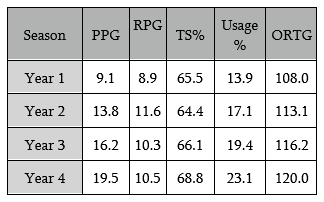
Duren entered the league as one of the youngest players in basketball and immediately established himself as an elite physical presence around the rim. Detroit initially simplified his offensive role, primarily using him as a vertical spacer, offensive rebounder, and rim-running finisher while relying on his athleticism to offset early defensive gaps. Production steadily climbed each season before eventually exploding into a 19.5 point, 10.5 rebound All-Star campaign during Year 4.
Detroit increasingly leaned into the Cunningham-Duren partnership offensively, expanding Duren’s screening and finishing responsibilities as the season progressed. His usage rate climbed to 23.1% while his true shooting percentage rose to 68.8%, allowing him to become one of the league’s most efficient interior scorers despite a much larger offensive role.
Regular Season vs Playoffs
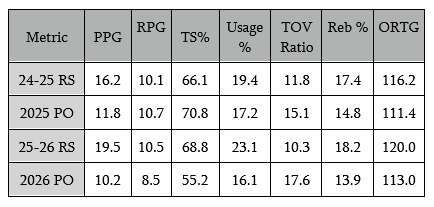
The playoffs complicated that evaluation quickly. Orlando and Cleveland consistently shrank the floor around Cunningham-Duren actions, reducing Duren’s offensive involvement and forcing quicker reads in traffic. His usage rate dropped from 23.1% to 16.1%, his true shooting percentage collapsed from 68.8% to 55.2%, and his turnover ratio spiked from 10.3 to 17.6.
After averaging 19.5 points during the regular season, Duren dropped to 10.1 in the playoffs, one of the largest postseason scoring declines by an All-Star in NBA history. The only All-Star to experience a larger scoring drop across a playoff sample of at least 10 games, per UnderdogNBA and The Athletic, was Wilt Chamberlain in 1962 - falling from 50.4 to 35.0.
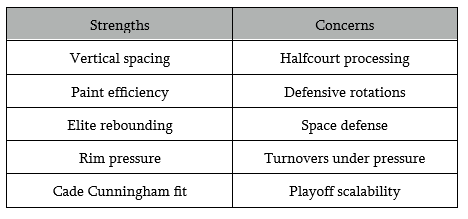
The defensive concerns were just as significant. Detroit’s rise was heavily tied to defense, athleticism, and consistent pressure outside of Cade Cunningham’s halfcourt creation, and Duren’s physical presence around the rim became an important part of that identity. The Pistons finished the regular season leading the NBA in both blocks and steals per game, but the playoffs exposed several underlying concerns evaluators had flagged, particularly: Duren’s defensive anticipation, rotational consistency, and ability to survive in space once offenses forced him into tighter halfcourt environments.
The concerns became even more noticeable late in games. During multiple playoff stretches against Orlando and Cleveland, Detroit closed with Paul Reed over Duren in critical possessions, prioritizing defensive activity, switchability, and faster decision-making. In Game 5 against Cleveland, Duren did not play during the fourth quarter or overtime while Reed helped stabilize Detroit defensively during the Cavaliers’ late run.
Strengths vs Concerns
Several notable centers have experienced similarly uneven playoff development curves early in their careers. Dwight Howard initially struggled with offensive fouls, free throw issues, and halfcourt physicality before eventually developing into a Finals-level centerpiece in Orlando. Tyson Chandler dealt with foul trouble, inconsistent offensive involvement, and defensive overreactions early in his postseason career before later evolving into one of the NBA’s most impactful playoff defensive anchors during Dallas’ 2011 title run. Jarrett Allen faced many of the same concerns now surrounding Duren, particularly questions surrounding physicality, offensive passivity, and whether his regular season impact would fully translate once playoff defenses tightened the floor. Others, like Deandre Ayton, initially appeared highly scalable during Phoenix’s Finals run before later matchup concerns, inconsistent motor questions, and fluctuating offensive involvement complicated his long-term valuation. Duren’s situation now sits somewhere in the middle of those developmental outcomes.
Duren’s decline was arguably the steepest of the group, particularly considering the combination of scoring drop-off, efficiency collapse, and turnover increase. At the same time, playoff development curves for young centers have historically looked far less linear than they do for guards and wings. That uncertainty is ultimately what makes Duren one of the NBA’s most complicated restricted free agency evaluations.
II. How does this translate to Market Value?
What is his maximum contract under the NBA CBA?
If Jalen Duren is selected for an All-NBA team later today, then his maximum contract from the Detroit Pistons would be for 5 years at $287.921M (AAV: $57.584M).
If he does not make an All-NBA team, then his maximum contract with the Pistons would be for 5 years at $239.935M (AAV: $47.987M).
A maximum contract from any other club would be for 4 years at $177.882M (AAV: $44.470M) – and the New Team would need to either have $41.368M in Room, or acquire via a Salary Cap Exception, most likely via Sign-and-Trade.
Those contracts are displayed below:
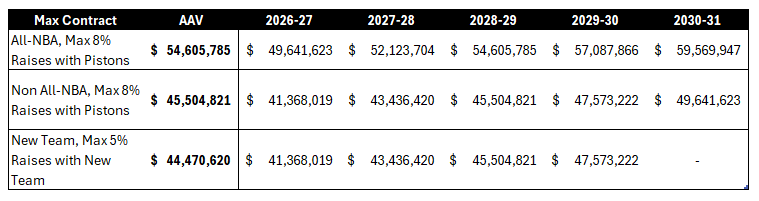
While Duren would be eligible to sign a Higher Max contract upon making an All-NBA team, he would be the first center to sign for more than 25.00% at Restricted Free Agency in 10+ years; and he would become only the 5th Restricted Free Agent under the current CBA, joining Anthony Edwards, Cade Cunningham, Evan Mobley, and Tyrese Haliburton.
Whether Detroit extends that will come down to his market and what Offer Sheets he can generate with a New Team.
Evaluating Duren’s Market High – the 2025-26 Regular Season
The optimistic outcome is compelling — Duren's offensive growth curve is uncommon for a 22-year-old center. Few young bigs combine his finishing efficiency, rebounding, physical tools, and production profile this early in their careers. If the defensive reads, rotational discipline, and decision-making improve even modestly, Detroit could be looking at a long-term All-NBA-caliber center whose early playoff struggles eventually become viewed as a normal part of big-man development. There have been very few similarly situated centers at RFA in this current CBA, and we must go back to the 2016 CBA for a decent market comparison.
The most optimistic evaluation we can take is by assessing Duren’s platform regular season where he outclasses the market.

Duren had the highest points per game, highest efficiency, highest VORP, and his rebounding metrics were second only to Andre Drummond.
If we were to weight Duren’s platform regular season against the best closest market comparisons, it is difficult to justify a valuation lower than the max.
Evaluating Duren’s Market Middle – Career Performance thus far
A more grounded assessment would require looking at Duren’s career production against the same market pool. This framing places Duren in the tier of “highly productive regular-season centers whose playoff value fluctuates with matchup and roster context.” The offensive production, rebounding, and Cade Cunningham fit would still justify major long-term money, but defensive flexibility concerns could continue limiting his ceiling deep into the postseason against more dynamic offenses – which was a common thread for each of these centers at the same stage.
Here is the same market pool through their first four seasons of play:

While Duren leads the class in VORP and TS%, the rest of his metrics are somewhat consistent with this pool. It is difficult to place his statistical output ahead of Ayton’s, and Duren is squarely ahead of Allen in all but TOV%. Drummond’s regular season production is the closest comparison we have; however we value Drummond’s career stats a shade higher due to his elite rebounding numbers through his first 304 games.
If we weight Duren’s career regular season production against the same market, a valuation around 22.0% - 23.0% would be consistent with market.
Evaluating Duren’s Market Low – Playoff Performance thus far

A caveat: the sample size is extremely small and varies greatly. Ayton played through two deep playoff runs which ended with appearances in the Finals and Western Conference Finals, Drummond played only four games in one series, and Jarrett Allen was on Nets teams that were eliminated in the first round. However, while the sample size may be small, Duren's postseason production most closely mirrors Allen's — similar counting stats and nearly identical advanced efficiency numbers.
Ayton, on the other hand, is interesting as his career playoff numbers are:
1) nearly identical to his career stats through the first four seasons; and
2) are only a shade below his platform season.
This will be a compelling narrative for the Pistons as they prepare for the Duren negotiations and look for defensible standards of max money in this market. Max money is reserved for those who can consistently produce at the level Duren has for both the regular season and the postseason.
If we weight Duren’s postseason against the same market, a valuation between Drummond and Allen around ~20.64% is consistent with playoff performance.
Valuation Conclusion
As you can see, Duren’s fair market valuation is fairly wide. Arriving at a Year 1% valuation requires weighing a promising young player's highs against the inevitable lows. Duren's platform year was strong, but his playoff performances leave room for growth. A ~22.50% Year 1 value is a reasonable anchor.

III. The Restricted Free Agency Game
Whether Duren ends up north or south of 22.50% will largely depend on how interested the rest of the league is. If there is little to no interest in committing to an Offer Sheet, expect that value closer to 20%. However, if there are significant Offer Sheet threats, the final value and structure can get really interesting. Presently, there are only three teams (CHI, LAL, BKN) with enough Room to field a sufficient Offer Sheet. The question then becomes: at what point, if any, does Detroit let Duren walk?
Does Detroit let him walk for 24%? Probably not.
What about the max at 25%? Probably not either.
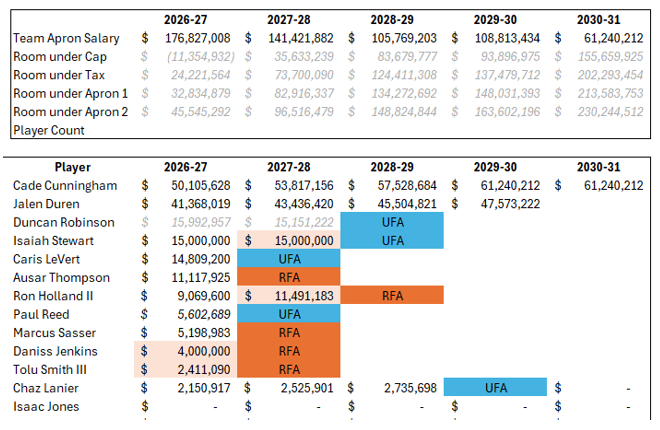
Up to 25%, the Pistons are matching into an okay deal; it could be an overpay, it could be a good-value contract. If anything, matching a New Team’s 4-year max saves them ~$7M compared to if they offered the same max with 8% raises.
Here is what a maximum Offer Sheet would look like on Detroit’s books:
Is there anything else a New Team could do to disincentivize Detroit’s matching?
Yes, a New Team has a few structural threats at their disposal. While they could add small things to make it as inconvenient for Detroit to match - namely, a 15% Trade Bonus, maxing out annual Performance Bonuses to affect Detroit’s Apron Team Salary accounting – the most interesting structural threat a New Team could tender would be for a short term max contract with a player option.
For example, Chicago, Los Angeles, or Brooklyn could offer a 25% max contract, with 5% raises, a 15% Trade Kicker, and a second year Player Option. If matched, that Offer Sheet would look like:
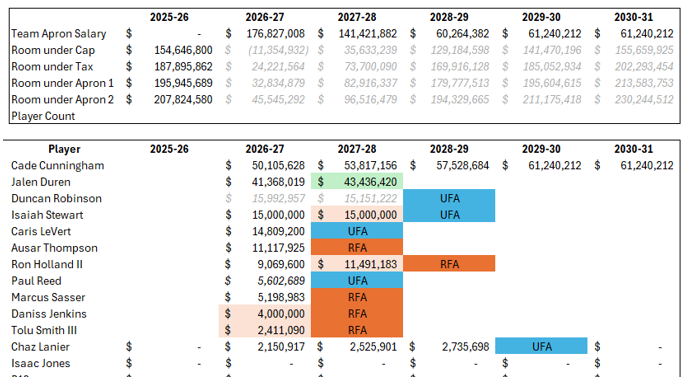
Detroit would lose certainty and control heading into a summer when they must also navigate RFA for Ausar Thompson, Marcus Sasser, Daniss Jenkins, and Tolu Smith (assuming none get extended or moved this summer). This would also give Duren a path to Unrestricted Free Agency as soon as next summer. If Detroit cannot work out an extension with him, the 15% Trade Bonus (worth approximately $6.2M) would be difficult to swallow and if traded, would be tacked on as dead cap.
While the same threats would also apply to whichever team extends an Offer Sheet in this spirit, clubs like Chicago and Brooklyn have much more cap flexibility and face significantly less cap leverage than a club with deep playoff expectations like Detroit. In particular, Chicago’s position is prime for a one-year max gamble. If things go well, Chicago has a promising offensive tandem of Giddey and Duren with a clear path to add a third star. If things do not go well, Chicago can trade Duren at the deadline or let him walk next summer (and have two max slots). Detroit does not have these luxuries.
While this is the most aggressive Offer Sheet structure available, it may also be unrealistic — as Chicago, Detroit, or Los Angeles are unlikely to commit $41.368M as ‘just’ a placeholder. Additionally, Detroit is outside Luxury Tax range for this summer and will have no present cap issues matching a 25% Offer Sheet. But this is the most aggressive threat a New Team could generate and - if matched - this contractual structure gives Duren immense leverage over the Pistons next summer, where they cannot afford to get many moves wrong.
The only way Detroit prevents this scenario from happening is by extending a Maximum Qualifying Offer — making Duren the highest-paid RFA center ever.